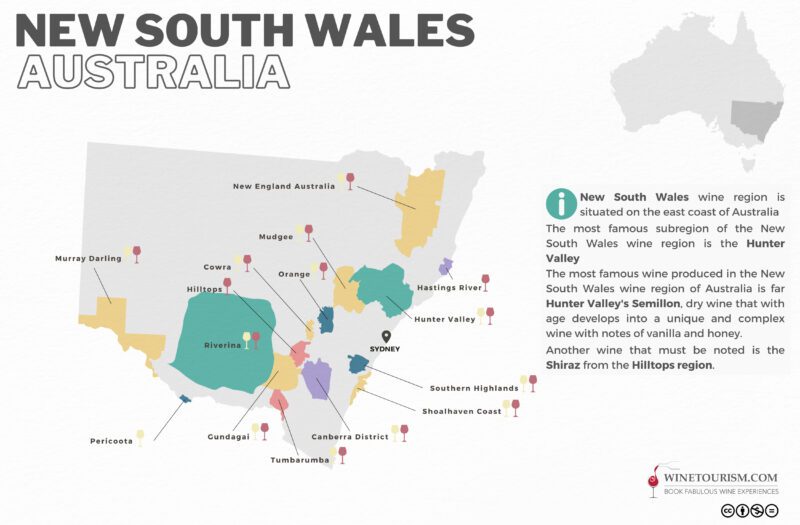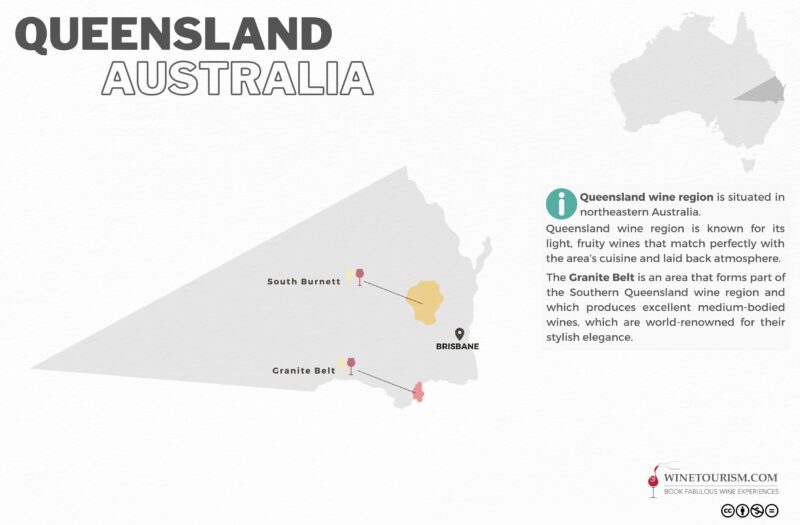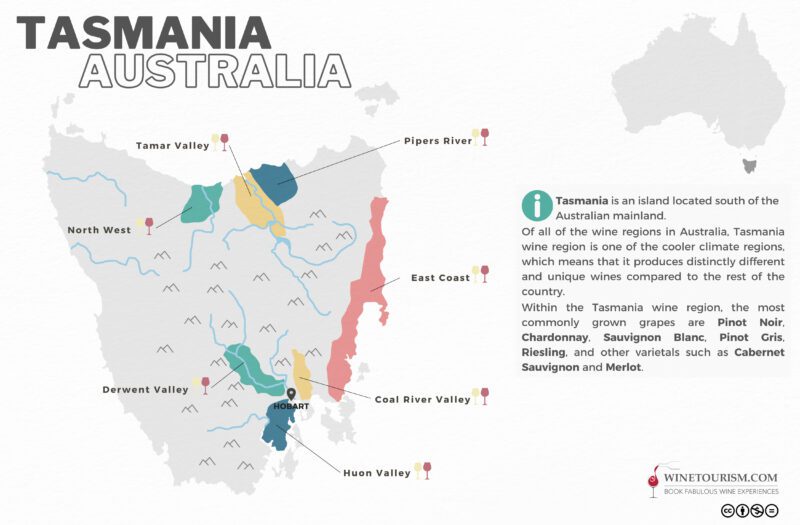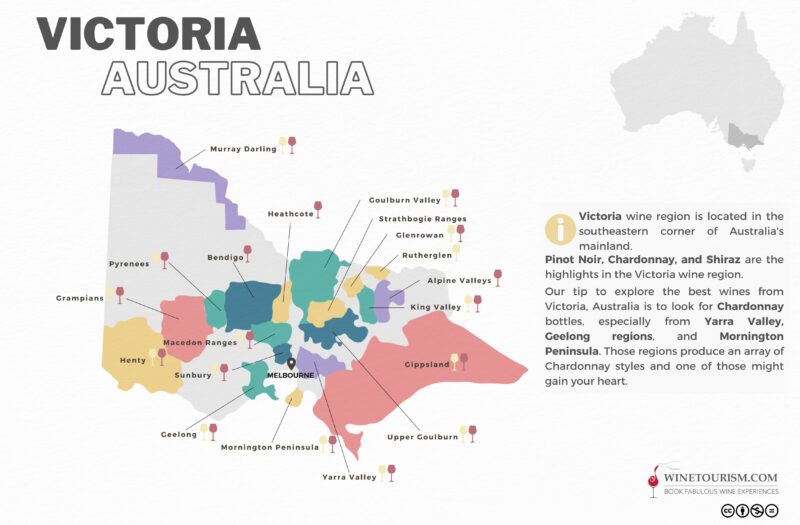
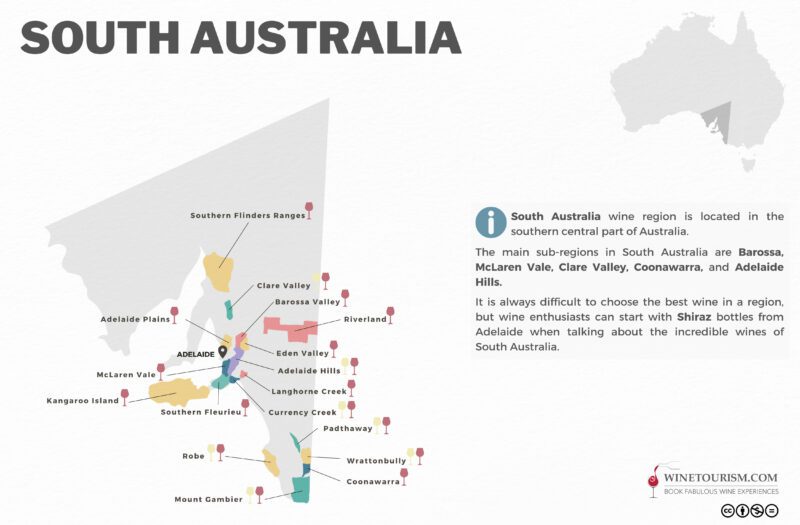
If you are looking for a free, high-resolution South Australia wine map, you can download it here: Download the full-size South Australia wine map. This map is useful if you want a clearer overview of the state that sits at the center of Australian wine, from famous names like Barossa and Clare Valley to coastal and cooler-climate regions such as McLaren Vale and Adelaide Hills.
South Australia matters because it is not just one strong region. It is the state that anchors much of the country’s wine identity. It combines historic old-vine areas, major production zones, cool-climate pockets, Mediterranean influences, and some of the best-known regional names in Australian wine. That is exactly why a South Australia wine map is so useful. It helps you place those names visually and understand why the wines can vary so much from one area to another.
If you want to browse more downloadable Australian wine maps after this one, see our Australia wine maps collection.
Key takeaways
- This free map gives you a clearer overview of the main wine regions across South Australia.
- South Australia is the most important state in Australian wine by scale, history, and global recognition.
- Barossa, Clare Valley, McLaren Vale, and Adelaide Hills are some of the key names to notice first.
- The state is associated with iconic styles such as Barossa Shiraz, Clare Valley Riesling, and McLaren Vale Grenache and Shiraz.
- This map is useful for wine study, travel planning, and linking famous labels to actual places.
Table of contents
- Why this map is useful
- Why South Australia matters in wine
- Key regions to notice on the map
- Main grapes and wine styles
- How to use this map
Why this South Australia wine map is worth downloading
A good wine map turns famous region names into something easier to understand and remember. That matters especially in South Australia, because the state contains several of the biggest names in Australian wine, yet those names are often talked about in isolation. People may know Barossa for Shiraz or Clare Valley for Riesling, but without a map it is much harder to understand how those regions relate to each other and to the wider South Australian landscape.
This map helps with exactly that. It gives you a more useful visual sense of where the best-known wine areas sit, how broad the state really is, and why South Australia can support such a wide range of wine styles. If you are trying to understand Australian wine more seriously, South Australia is one of the first places where geography really starts to matter.
Why South Australia matters in Australian wine
South Australia is the historic and commercial heart of Australian wine. It produces the majority of the nation’s wine and includes some of the country’s most famous and best-established regions. It is also home to some of the oldest vines in the world, including old vineyards that survived the phylloxera devastation that destroyed so many historic vineyards elsewhere. That combination of scale, heritage, and quality is a big part of what gives the state its status.
But South Australia is not important only because it is big. It matters because it is diverse in a very useful way. Barossa is not Clare Valley. McLaren Vale is not Adelaide Hills. Riverland plays a different role from all of them. The state gives you warm-climate power, fresher elevated styles, Mediterranean expressions, and large-scale production all in one place. A map helps make that diversity much easier to grasp.
If you are comparing South Australia with the rest of the country, you may also want to see our New South Wales wine map and Queensland wine map.
Key regions to notice on the map
Barossa
Barossa is one of the most famous names in Australian wine and one of the first regions most people should lock into place on a South Australia wine map. It is especially known for Shiraz, old vines, and a broad red wine culture that has helped shape Australia’s global image for decades. Official Wine Australia material points to Barossa Valley Shiraz and Eden Valley Riesling as two of the zone’s star performers, which already tells you a lot about the region’s internal range.
Barossa is also historically important because it is home to some of the oldest continuously growing Shiraz, Cabernet Sauvignon, Grenache, Mataro, and Riesling vines in the world, with vineyards dating back to the 1840s. On a map, Barossa acts as one of the main anchors of South Australia wine geography.
Clare Valley
Clare Valley is one of the other essential names to spot immediately. It has a particularly strong association with Riesling, to the point where the grape has become almost synonymous with the region in Australian wine. Clare Valley Riesling is known for a restrained, lime-toned, mineral style that often ages very well, and the region is also important for Shiraz and Cabernet Sauvignon.
What makes Clare especially useful on a map is that it reminds you South Australia is not only about broad, full-bodied reds. It also includes regions with a very strong identity around freshness, line, and age-worthy white wine.
McLaren Vale
McLaren Vale is another of South Australia’s major names and one of the state’s most important warm-climate regions. It sits south of Adelaide near the coast, where ocean influence helps create real meso-climate variation. Wine Australia describes the region as especially associated with Shiraz, Cabernet Sauvignon, Grenache, and Chardonnay, though Shiraz remains the dominant name and Grenache has become a major talking point in its own right.
McLaren Vale matters because it gives South Australia a different expression of warmth from Barossa. It is still powerful and generous, but with a Mediterranean identity, major soil diversity, and a strong modern reputation for Grenache as well as Shiraz.
Adelaide Hills
Adelaide Hills brings a cooler-climate counterpoint to the more powerful warm-climate image people often have of South Australia. Wine Australia describes it as South Australia’s coolest wine region and highlights styles such as traditional method sparkling wine, Sauvignon Blanc, Chardonnay, Pinot Noir, and Shiraz. That makes it one of the most important regions on the map if you want to understand the state beyond its classic red wine image.
Adelaide Hills is especially useful as a reminder that South Australia is not one-note. It is part of the reason the state can speak to drinkers who want freshness and elegance as well as those who want depth and power.
Riverland and the broader production picture
Not every important region is important for the same reason. Riverland deserves attention because it represents the broader production story of South Australian wine. While it does not always dominate prestige conversations the way Barossa or Clare Valley do, it matters because it helps explain how South Australia became such a central force in national wine output. A map helps put that scale into perspective.
Main grapes and wine styles to connect with the map
One of the easiest ways to use a wine map is to connect major places with major grape styles. In South Australia, that becomes especially useful.
Shiraz is one of the key grapes to associate with the state, and especially with Barossa and McLaren Vale. Barossa Shiraz in particular is one of the best-known red wine styles in Australia, with a reputation for full-bodied, richly textured wines showing blackberry, pepper, and spice. If you want a broader refresher on the grape, see our guide to Syrah/Shiraz in our grape varieties overview.
Riesling is another essential South Australia grape because of Clare Valley and Eden Valley. Clare Valley in particular has become a benchmark region for Australian Riesling and accounts for a significant share of the country’s total Riesling production. If Riesling is your way into the map, the grape deserves to sit high on your South Australia study list.
Grenache matters strongly in both Barossa and McLaren Vale, where old-vine Grenache has become increasingly important in both blends and single-varietal wines. McLaren Vale, in particular, has a strong modern identity around Grenache as well as Shiraz.
Cabernet Sauvignon and Chardonnay also belong in the South Australia conversation, especially when you move beyond the simplest regional stereotypes. Together, these varieties help show just how broad the state really is stylistically.
How to use this map if you are planning a trip, tasting, or study session
If you are planning a wine trip, this map gives you a much better sense of how South Australia’s regions relate to Adelaide and to one another. That matters because the state is often talked about as if everything were part of one compact wine destination, when in reality different regions offer very different experiences, climates, and wine identities.
If you are studying wine, start by linking Barossa with Shiraz and old vines, Clare Valley with Riesling, McLaren Vale with Shiraz and Grenache, and Adelaide Hills with cooler-climate styles. Once those four are fixed in place, South Australia becomes much easier to understand as a whole.
If you are tasting at home, the map can also help you structure a regional comparison. Try a Barossa Shiraz, a Clare Valley Riesling, a McLaren Vale Grenache or Shiraz, and a fresher Adelaide Hills Chardonnay or Sauvignon Blanc. That kind of line-up makes the geography feel real very quickly, which is exactly what a good wine map should do.
Map credit
Wine map kindly provided by WineTourism.com.
Read next
- Australia Wine Maps
- New South Wales Wine Region Australia Free Wine Map
- Queensland Wine Region Australia Free Wine Map
Last updated: