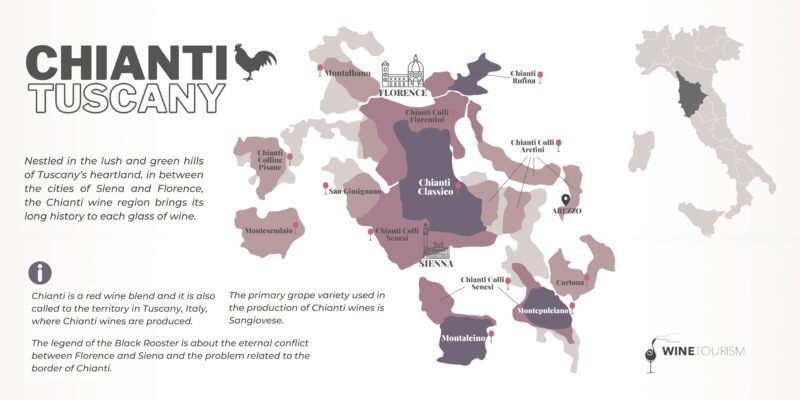
If you are looking for a free Chianti wine region map, you can download the full-size version below. Chianti is one of Italy’s most recognisable wine areas, known for Sangiovese-based red wines, classic Tuscan landscapes, and a wine identity that combines tradition, food-friendliness, and broad international appeal.
Download the full-size Chianti wine region map here
Key takeaways
- Chianti is one of Tuscany’s most famous wine regions.
- The area is strongly associated with the Sangiovese grape.
- Chianti wines are known for cherry fruit, balanced acidity, and a smooth finish.
- The region combines wine history, scenic vineyards, and strong travel appeal.
- You can download a free high-resolution Chianti wine map from the link above.
Table of contents
- Download the map
- Where Chianti is
- Why Chianti matters
- What the region is known for
- Sangiovese and wine style
- Landscape, travel, and regional identity
- Why this map is useful
Download the map
This page gives you access to a free, detailed, high-resolution wine map of the Chianti wine region in Italy. It is useful if you want a clearer overview of one of Tuscany’s best-known wine areas, whether for wine study, travel planning, or general interest.
Click here to open and download the full-size map
Where Chianti is
Chianti is located in Tuscany, Italy, and for many readers it is one of the first wine regions that comes to mind when they think about classic Italian red wine. The name carries real recognition, not only because of the wines, but also because of the landscapes and broader Tuscan image that surround it.
The region is known for rolling vineyards, charming villages, and historical wineries. That setting is a big part of the appeal. Chianti does not feel like a wine region that exists only on a label. It feels like a place people can picture immediately, and that makes a map especially useful.
For readers who know the name Chianti from restaurants, travel guides, or supermarket shelves, a regional map helps turn that familiarity into something more concrete. It shows where the wines come from and gives the region a clearer shape inside the wider geography of Tuscany.
Why Chianti matters
Chianti matters because it is one of Italy’s most recognisable and influential wine names. It works as both an introduction to Tuscan wine and a region with enough depth to keep more experienced wine drinkers interested.
The region also matters because it bridges quality and accessibility. Chianti is important enough to be taken seriously in wine conversations, but familiar enough that it does not feel intimidating. That balance is one reason it has remained so widely loved over time.
For Corked News, Chianti is especially useful because it connects well to several kinds of reader intent at once. Some readers are looking for classic Tuscan wine education. Others are interested in scenic travel or iconic Italian destinations. Chianti works for both.
What the region is known for
Chianti is renowned for world-class red wines built around the Sangiovese grape. That is the clearest starting point for understanding the region. If someone knows only one thing about Chianti, it is usually that the wines are red, Tuscan, and closely tied to Sangiovese.
The wines are often associated with vibrant cherry flavours, balanced acidity, and a smooth finish. That profile is part of what has made Chianti such a reliable and food-friendly wine name for so long. It feels lively rather than heavy, and structured rather than harsh.
That style also helps explain why Chianti has such broad appeal. It is not just admired by collectors or specialists. It is a region whose wines are often loved because they are enjoyable, versatile, and easy to pair with food.
Sangiovese and wine style
The grape most closely associated with Chianti is Sangiovese, and that relationship is central to the region’s identity. Sangiovese gives Chianti much of its bright red fruit, freshness, and shape, and it is one of the reasons the wines often feel energetic rather than heavy.
Cherry fruit is one of the flavour notes most often linked to Chianti, but the grape also helps drive the region’s balance. The acidity gives the wines lift, which is a big part of why they pair so naturally with food. That freshness is not a side detail. It is one of the most important reasons Chianti remains such a dependable classic.
For readers, Chianti is also a useful way to understand Sangiovese more broadly. The region gives the grape one of its most recognisable expressions, making it a strong entry point into Tuscan wine and Italian red wine more generally.
Landscape, travel, and regional identity
Chianti has unusually strong travel appeal because the region’s wine identity and visual identity are so closely connected. Vineyards, villages, and long-established estates all help create a setting that feels instantly Tuscan. That is part of why Chianti remains so magnetic for wine tourism.
The historical wineries and countryside scenery reinforce the region’s sense of continuity. Chianti feels rooted. It feels like one of those places where wine is not just produced, but woven into the landscape and the daily life of the area.
That makes Chianti especially strong for map content. Readers often want more than a basic wine description. They want to picture the place, understand where it sits, and connect the wine with the landscape that made it famous.
Why this map is useful
A Chianti wine region map is useful because the name is so famous that many readers assume they already understand it. In reality, they often know the wines better than the geography. A map helps close that gap.
This page gives readers a practical way to place Chianti within Tuscany and to connect the name to an actual regional setting. That is useful for wine learning, travel planning, and comparing Chianti with other Italian wine regions.
The map is also useful because Chianti is one of those regions that naturally supports both education and travel content. It works as a wine region, a destination, and a reference point for Italian wine more broadly. That makes it a strong evergreen page for Corked News.
It also supports internal linking naturally. Chianti connects well to Sangiovese content, Tuscany travel pages, Italian wine region articles, and the wider wine maps hub. That makes the page useful on its own while also strengthening the larger site structure.
See also our Wine Travel Ideas for Italy.
Wine map kindly provided by WineTourism.com.
Read next
Last updated: