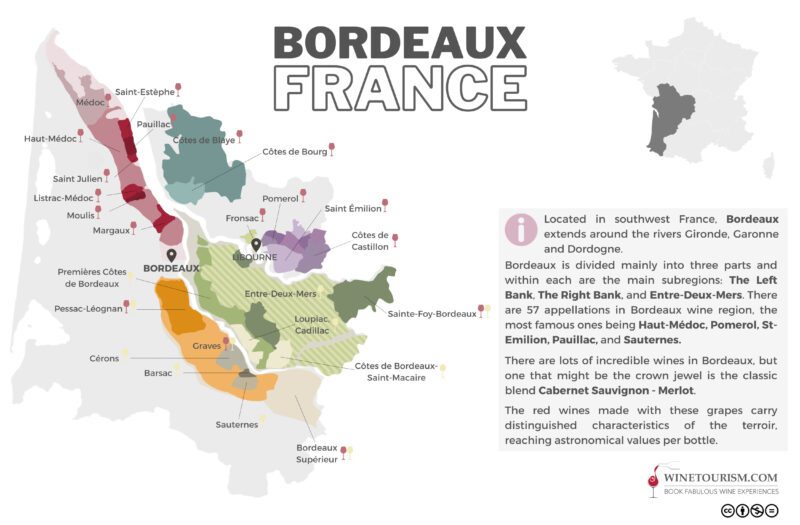
If you are looking for a free Bordeaux wine region map, you can download the full-size version below. Bordeaux is one of the most famous wine regions in the world, known for prestigious châteaux, age-worthy blends, and a wine culture that has shaped how many people think about fine wine.
Download the full-size Bordeaux wine region map here
Key takeaways
- Bordeaux is one of France’s most important and internationally recognised wine regions.
- The region is known for red blends, dry whites, and famous sweet wines.
- Its maritime climate and varied soils help shape its distinctive wine styles.
- The Left Bank and Right Bank are central to understanding Bordeaux.
- You can download a free high-resolution Bordeaux wine map from the link above.
Table of contents
- Download the map
- Why Bordeaux matters
- What the region is known for
- Climate, soils, and terroir
- Left Bank, Right Bank, and beyond
- Heritage and global influence
- Why this map is useful
Download the map
This page gives you access to a free, detailed, high-resolution wine map of the Bordeaux wine region in France. It is useful if you want a clearer overview of one of the world’s most influential wine areas, whether for travel planning, wine study, or general interest.
Click here to open and download the full-size map
Why Bordeaux matters
Bordeaux matters because it has shaped the global language of wine. For many readers, it is one of the first names that comes to mind when people talk about classic French wine. It has history, prestige, recognisable appellations, and a reputation built over centuries.
What makes Bordeaux especially important is that it is not just one wine style. It is a full wine world of its own. The region is known for red blends above all, but it also produces dry whites and famous dessert wines. That range gives Bordeaux a broader identity than many other major regions.
It also remains one of the strongest examples of how place, grape varieties, and tradition work together. Bordeaux is not simply famous because of branding. It is famous because the region built a lasting model for quality, classification, and regional distinction that still matters today.
What the region is known for
Bordeaux is world-renowned for exceptional red, white, and dessert wines. That alone makes it a highly useful region for map-based content, because readers often know the name but not the geography behind it. A good map helps connect the reputation to the real landscape.
The region is especially associated with iconic blends. On the red side, Bordeaux is closely linked with grapes such as Cabernet Sauvignon, Merlot, and Cabernet Franc, with other varieties also playing a supporting role. On the white side, grapes like Sémillon and Sauvignon Blanc are central. The sweet wines are equally important to Bordeaux’s wider identity.
Bordeaux is also known for elegance, complexity, and wines that often improve with age. That is a major part of the region’s appeal. It has become one of the benchmark names for readers interested in structured, terroir-driven wines with long-term reputation and global recognition.
Climate, soils, and terroir
The maritime climate of Bordeaux is one of the foundations of the region’s success. Its proximity to the Atlantic helps moderate conditions, creating relatively mild winters and warm summers. That balance is a major reason why the region can support such a wide range of grape varieties and wine styles.
Soils matter just as much. Bordeaux is often discussed through its gravel, clay, and limestone soils, and those differences are a big part of why the region produces such varied wines. Soil type affects drainage, vine behaviour, and ultimately the character of the wine.
This combination of climate and soils gives Bordeaux its terroir-driven identity. It also helps explain why the region cannot be reduced to a single style. Bordeaux is unified by reputation, but within that reputation there is real diversity. A map helps make that easier to see and understand.
Left Bank, Right Bank, and beyond
One of the most useful ways to understand Bordeaux is through its sub-regions. The Left Bank and Right Bank are central concepts, and readers often hear those names long before they understand what they mean geographically. That is one of the strongest reasons this kind of map page is valuable.
The Left Bank, including areas such as Médoc and Graves, is generally associated with powerful, structured red wines, often with Cabernet Sauvignon playing a major role. These are the wines many readers associate with traditional Bordeaux prestige and long aging potential.
The Right Bank, including Pomerol and Saint-Émilion, is known for richer, more plush Merlot-based wines. That gives Bordeaux an important stylistic contrast within the same broader region. It helps explain why Bordeaux can appeal to very different tastes while still maintaining a coherent regional identity.
Then there are other important areas, including Entre-Deux-Mers, which adds another layer to the region’s reputation with approachable white wines. Together, these sub-regions show why Bordeaux is better understood as a network of connected wine places rather than a single uniform area.
Heritage and global influence
Bordeaux has one of the deepest winemaking legacies in the world. Its heritage stretches back to Roman times, and over the centuries the region built systems, traditions, and a reputation that still shape how wine is discussed today. That historical weight gives Bordeaux unusual authority in the global wine conversation.
The region’s famous classification systems are part of that story. They reinforced the prominence of Bordeaux châteaux and helped define ideas of hierarchy, prestige, and collectability in wine. Even readers who are not experts often recognise that Bordeaux carries this sense of heritage in a way few regions do.
At the same time, Bordeaux is not frozen in the past. Modern producers continue to work with both tradition and innovation. Sustainability, vineyard management, and technical improvements all matter, but the region still manages to feel rooted in something much older. That balance between continuity and adaptation is a major part of its enduring strength.
Why this map is useful
A Bordeaux wine region map is useful because Bordeaux is one of those places people think they know until they try to place its sub-regions, rivers, and styles in a real geographic context. A map makes the region easier to understand immediately.
It is especially helpful for readers comparing Left Bank and Right Bank wines, planning a trip, or exploring French wine more seriously. Bordeaux is too important a wine region to leave abstract. A visual overview makes the structure of the region much easier to grasp.
This kind of page also works well because Bordeaux has both high search familiarity and high educational value. Readers may arrive because they already know the name, but the map gives them something practical and lasting. It turns reputation into orientation.
For Corked News, Bordeaux also fits naturally into broader content on wine maps, France, wine travel, grape varieties, and regional guides. It is one of the strongest internal linking hubs possible because it connects so many wine topics at once.
See also our Wine Travel Ideas for France.
Wine map kindly provided by WineTourism.com.
Read next
Last updated: