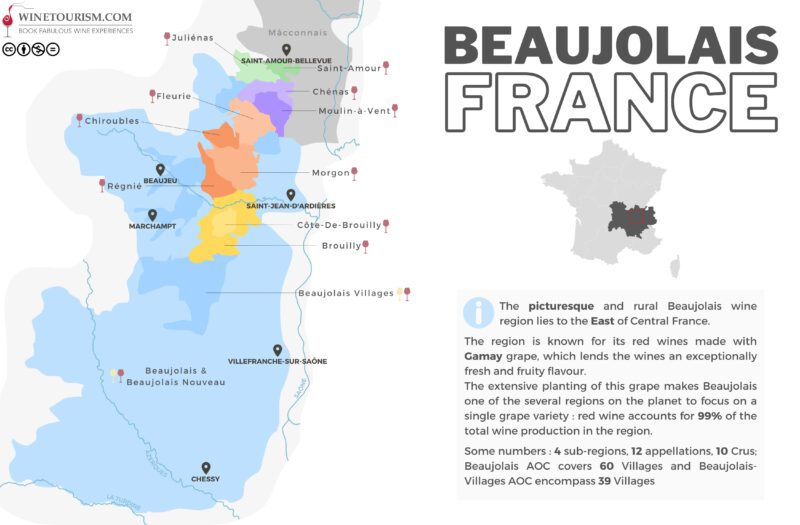
If you are looking for a free Beaujolais wine region map, you can download the full-size version below. Beaujolais is one of France’s most recognisable wine areas, known for lively Gamay-based reds, approachable fruit-driven wines, and a wine culture that feels both traditional and easy to enjoy.
Download the full-size Beaujolais wine region map here
Key takeaways
- Beaujolais is best known for red wines made primarily from Gamay.
- The region is widely associated with fresh, fruity, low-tannin wine styles.
- Beaujolais Nouveau helped make the area famous around the world.
- The landscape combines vineyard slopes, wine villages, and strong regional identity.
- You can download a free high-resolution Beaujolais wine map from the link above.
Table of contents
- Download the map
- Why Beaujolais stands out
- What the region is known for
- Landscape, climate, and style
- Wine identity and appeal
- Why this map is useful
Download the map
This page gives you access to a free, detailed, high-resolution wine map of the Beaujolais wine region in France. It is useful if you want a better overview of the area, are comparing French wine regions, or are planning a wine-focused trip through eastern France.
Click here to open and download the full-size map
Why Beaujolais stands out
Beaujolais stands out because it offers a very clear wine identity. Even people who are not deeply into French wine often know the name, usually because of Beaujolais Nouveau. But the region is more than one annual release. It is a full wine area with its own geography, traditions, and style.
What makes it especially memorable is that it feels approachable. Some French regions can seem formal or difficult at first glance. Beaujolais often feels more open. The wines are easy to enjoy, the grape is easy to remember, and the region has a strong connection to freshness and drinkability.
That does not mean it lacks depth. Quite the opposite. Beaujolais is one of those regions where a simple public image often hides a more interesting reality. A map helps readers move beyond the surface and understand the region as a real place, not just as a wine label or a seasonal headline.
What the region is known for
Beaujolais is renowned for vibrant and youthful red wines made primarily from Gamay grapes. That single fact gives the region a very strong identity. While many famous French wine areas are built around blends or multiple key styles, Beaujolais is closely tied to one grape and a recognisable expression of it.
Those wines are often associated with fresh fruit flavours, low tannins, and an easy-drinking style. That is a major part of the region’s appeal. It attracts readers who want red wines that feel lively and expressive without being too heavy or overly structured.
Beaujolais Nouveau also plays a big role in the region’s image. Its annual release helped turn Beaujolais into an internationally recognised name. Even readers who know very little about French wine have often heard of that tradition. It continues to act as a doorway into the wider Beaujolais story.
Beyond that, the region also has a visual and cultural charm that suits map content especially well. Vineyard landscapes, local wine villages, and a strong regional identity all make Beaujolais easy to explore through both text and image.
Landscape, climate, and style
Beaujolais sits within the wider Burgundy sphere, but it has its own personality. That matters because readers often confuse regional relationships in France. A dedicated Beaujolais map helps separate the region clearly and gives it the space it deserves.
The landscape is part of the appeal. Vineyards and charming villages help define the region visually, and that makes it easier for readers to connect the wines to the place they come from. Beaujolais is one of those areas where wine and scenery naturally reinforce each other.
Its style is also linked closely to that setting. Wines from Beaujolais are often described as vibrant and youthful, and that tone fits the region’s public identity. The wines tend to feel immediate, expressive, and social. They are often introduced as friendly wines, and that reputation has real value for both readers and search intent.
A map becomes more useful in a region like this because it helps turn a familiar wine name into a real geographical area. That matters for education, internal linking, and travel relevance.
Wine identity and appeal
Beaujolais has one of the clearest wine identities in France. Gamay is central, and the wine style is easy to understand, which makes the region highly accessible. That is useful from an editorial perspective because it allows the page to serve both beginners and more advanced readers.
For newer readers, Beaujolais is a good introduction to French red wine outside the usual heavier regions. For more experienced readers, the region still has strong appeal because it offers freshness, regional character, and wines that can be both simple and surprisingly nuanced.
The region also benefits from a recognisable cultural rhythm. Beaujolais Nouveau gives it annual relevance, while the broader region keeps readers engaged beyond that one moment. That makes it especially valuable for a site covering wine maps, wine travel, and wine region education.
Beaujolais is also useful in content strategy because it naturally connects to Burgundy, Gamay, French wine travel, and broader red wine education. That gives this kind of page strong internal linking potential across multiple article types.
Why this map is useful
A Beaujolais wine region map is useful because it gives readers a clearer way to understand a region they may already know by name but not by geography. Many people know the wines. Fewer know where the region sits, how it fits into France, or why it matters beyond Beaujolais Nouveau.
This map helps solve that quickly. It gives readers a practical overview they can use for wine learning, travel planning, or general research. It is especially helpful for readers comparing French wine regions or trying to connect grape variety to place.
The map is also useful because Beaujolais is one of the easiest wine regions to turn into strong educational content. It has a clear grape, a recognisable style, and a name that many readers already know. That combination makes visual support especially effective.
For Corked News, pages like this work well because they combine search value with evergreen usefulness. A Beaujolais map page can support broader content on France, wine maps, wine travel, and grape-specific articles while still being useful on its own.
See also our Wine Travel Ideas for France.
Wine map kindly provided by WineTourism.com.
Read next
Last updated: