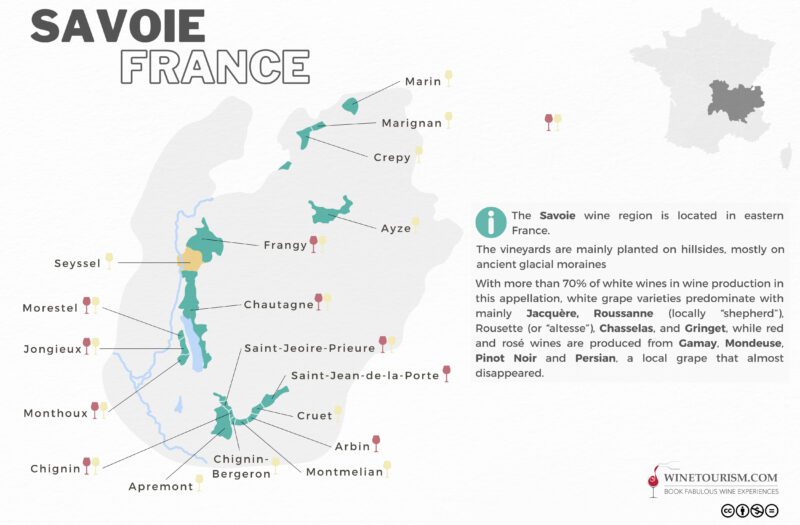
If you are looking for a free Savoie wine region map, you can download the full-size version below. Savoie is one of France’s most distinctive alpine wine regions, known for fresh whites, local grapes, mountain scenery, and a wine identity that feels very different from the country’s larger and more famous areas.
Download the full-size Savoie wine region map here
Key takeaways
- Savoie is a scenic wine region in eastern France with a strong alpine identity.
- The region is especially known for refreshing white wines and local grape varieties.
- Savoie also produces delicate reds and sparkling Crémant.
- Its cool climate and mountain terroir help shape a distinctive regional wine style.
- You can download a free high-resolution Savoie wine map from the link above.
Table of contents
- Download the map
- Where Savoie is
- Why Savoie stands out
- Wine types and grapes
- Climate, terroir, and style
- Why this map is useful
Download the map
This page gives you access to a free, detailed, high-resolution wine map of the Savoie wine region in France. It is useful if you want a clearer overview of one of the country’s lesser-known but highly distinctive wine areas, whether for wine study, travel planning, or general interest.
Click here to open and download the full-size map
Where Savoie is
Savoie is located in eastern France, close to the Alps, and that setting defines almost everything about the region. This is not a broad, low-lying wine area with one dominant style. It is a mountain-influenced region where altitude, cooler conditions, and alpine surroundings all shape the wines in a very visible way.
For many readers, Savoie feels like a hidden gem because it sits slightly outside the standard list of famous French wine regions. That makes a map especially useful. People often know the name vaguely, but they do not always have a clear sense of where it is or why it matters.
The scenery is also part of the appeal. Savoie is one of those regions where the visual setting strengthens the wine identity. Vineyards with mountain backdrops, smaller production areas, and a more local character all help make the region memorable.
Why Savoie stands out
Savoie stands out because it offers something very different from the usual image of French wine. Instead of being defined by major prestige labels or famous luxury estates, it is better known for freshness, local grapes, regional character, and a strong connection to place.
That gives the region real value for readers who want to go beyond the obvious. Savoie is often the kind of place wine enthusiasts discover after they already know the basics of Bordeaux, Burgundy, and Champagne. It feels more regional, more specific, and in many ways more personal.
It also stands out because of its balance. The wines are often lighter, fresher, and more food-friendly than the heavy styles many casual readers first associate with French wine. That makes Savoie especially attractive for people interested in alpine food pairings, mountain travel, and lesser-known regional specialties.
Wine types and grapes
Savoie is known for an appealing mix of refreshing whites, delicate reds, and sparkling Crémants. That diversity gives the region more range than many first-time readers expect. Even though white wine often leads the conversation, Savoie is not limited to one simple style.
The white wines are especially important. Grapes such as Jacquère and Altesse help define the region’s identity and give Savoie much of its local character. These wines are often appreciated for freshness, lift, and a sense of mountain-grown clarity that feels very different from richer or more heavily oaked white wine styles.
Savoie also produces delicate reds, often from grapes such as Gamay and Mondeuse. These reds help broaden the region’s appeal and show that Savoie is not only about crisp alpine whites. On top of that, sparkling Crémant adds another layer to the region’s profile and makes it even more versatile from a wine tourism point of view.
Climate, terroir, and style
The cool climate of Savoie is central to the region’s wine identity. Alpine influence helps preserve freshness in the grapes, and that freshness is one of the first things many drinkers notice in the wines. Savoie does not usually aim for power. It aims for clarity, brightness, and character.
The terroir also plays a major role. Mountain surroundings, changing elevations, and local site differences all help shape the style of the wines. In a region like this, geography is not just background detail. It is part of the explanation for why the wines feel so distinctive.
That is one reason Savoie makes a strong wine map page. A visual overview helps readers understand that this is a region shaped by terrain. Once you picture the vineyards against the alpine landscape, the wine style makes more sense.
Why this map is useful
A Savoie wine region map is useful because the region is interesting enough to attract curiosity, but not always familiar enough for readers to place clearly. Many know it is in France. Fewer know exactly where it sits, what it produces, or why it stands apart from better-known regions.
This map helps solve that. It gives readers a practical way to connect the name Savoie with an actual wine landscape. That is valuable for wine learning, regional comparison, and trip planning alike.
The map is also especially useful for travel-minded readers. Savoie naturally connects wine with mountain scenery, local culture, and a different side of French wine tourism. It is the kind of region that benefits from visual orientation because place is such a big part of the story.
For Corked News, this page also supports strong internal linking across France wine travel content, hidden gem wine regions, regional map pages, and grape variety content tied to alpine or lesser-known French wines. It is the kind of evergreen page that quietly strengthens the broader site structure while still being genuinely useful on its own.
See also our Wine Travel Ideas for France.
Wine map kindly provided by WineTourism.com.
Read next
Last updated: