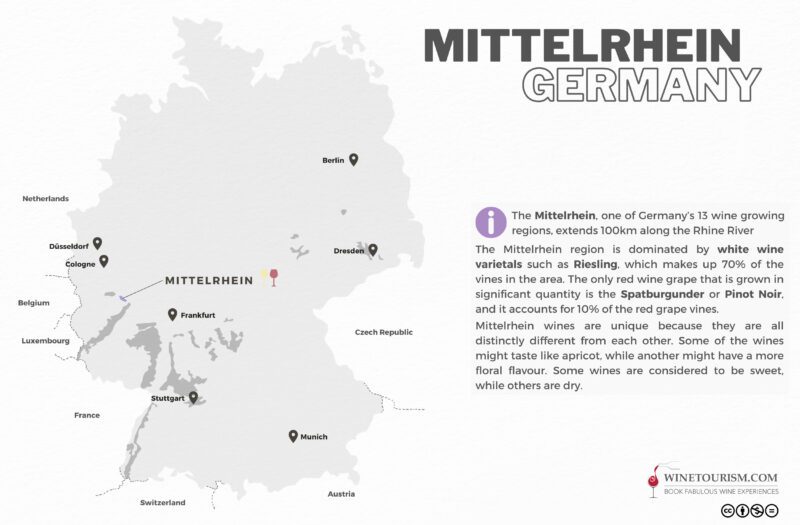
If you are looking for a free Mittelrhein wine region map, you can download the full-size version below. Mittelrhein is one of Germany’s most scenic wine regions, known for steep vineyards along the Rhine, castle-dotted landscapes, and elegant Riesling wines shaped by cool-climate conditions and slate-rich soils.
Download the full-size Mittelrhein wine region map here
Key takeaways
- Mittelrhein is one of Germany’s most visually striking wine regions.
- The region follows the Rhine River and is known for steep vineyard slopes.
- Riesling is the best-known grape associated with Mittelrhein.
- Slate soils and a cool climate help create elegant, aromatic, balanced wines.
- You can download a free high-resolution Mittelrhein wine map from the link above.
Table of contents
- Download the map
- Why Mittelrhein matters
- What the region is known for
- Why the region stands out
- Why this map is useful
Download the map
This page gives you access to a free, detailed, high-resolution wine map of Mittelrhein in Germany. It is useful if you are planning a wine trip, exploring German wine geography, or trying to understand where this historic Rhine region fits within the broader German wine landscape.
Click here to open and download the full-size map
Why Mittelrhein matters
Mittelrhein matters because it brings together several of the things people often love most about German wine in one place. It has dramatic river scenery, steep vineyard slopes, strong Riesling identity, and a long connection between landscape, culture, and wine. Some wine regions are mainly important for production volume or market recognition. Mittelrhein matters for a different reason. It feels like a region where the visual setting and the wine identity are tightly linked.
The region also matters because it helps explain why Germany is such a compelling wine country. German wine is not just about grape names or sweetness levels. It is also about geography, slope, climate, and the way rivers shape viticulture. Mittelrhein is one of the clearest places to see that. The Rhine is not just a backdrop here. It is part of the reason the region exists as a wine landscape at all.
For readers trying to understand the classic German wine map, Mittelrhein adds depth. It may not always be the first region casual drinkers name, but it is one of those places that makes the whole national picture more complete. Once you look at the map and place it properly, the region starts to make much more sense, both visually and stylistically.
What the region is known for
Mittelrhein is best known for its steep vineyards that rise above the Rhine River. That visual identity is central to the region. These slopes are not just beautiful. They also shape the viticulture in practical ways, influencing sun exposure, drainage, and how the vines interact with the local environment.
The region is especially associated with Riesling. That matters because Riesling is one of Germany’s defining grapes, and Mittelrhein offers one of the more elegant, focused, cool-climate expressions of it. The wines are often valued for aromatic lift, freshness, and balance rather than simple weight or ripeness. That gives Mittelrhein a clear stylistic identity that fits well within the wider German tradition.
Mittelrhein is also known for its cool climate and slate soils. Those two elements are often mentioned together for a reason. The cooler conditions help preserve acidity and precision, while slate is associated with tension, mineral character, and structure in the finished wines. That combination helps explain why the wines are often described as elegant and well-balanced rather than broad or heavy.
There is also a cultural side to what the region is known for. Mittelrhein is one of those places where wine feels woven into the setting. Castles, river views, terraces, and villages all contribute to the impression that this is not just a productive vineyard zone but a historic wine landscape in the fuller sense.
Why the region stands out
Mittelrhein stands out first because of its scenery. Even among beautiful wine regions, it has a particularly strong visual identity. The combination of steep slopes, the Rhine River, and fairytale-like castles gives the area a sense of atmosphere that is hard to confuse with anywhere else. For many readers, a map of Mittelrhein is appealing not only because it is useful but because it immediately evokes a distinctive place.
The region also stands out because it offers a more refined and classic expression of cool-climate German wine. If someone wants to understand why Riesling remains such a serious grape, Mittelrhein is one of the regions that helps tell that story. The wines are not just refreshing. At their best, they carry precision, aroma, and a clear sense of origin.
Another reason Mittelrhein stands out is that it sits at the intersection of wine, travel, and heritage. Some wine regions are easier to explain only through tasting notes or grape varieties. Mittelrhein is easier to understand once you see the landscape. That makes maps especially useful here, because the geography is part of the identity, not just a background detail.
It also stands out because it offers a slightly different perspective within Germany. While many readers may know names like Mosel or Rheingau first, Mittelrhein adds another piece to the puzzle. It shows that the Rhine corridor contains several important wine stories, each with its own shape, tone, and style.
Why this map is useful
A Mittelrhein wine region map is useful because it turns a regional name into something visual and concrete. Many readers know the name only loosely, or they connect it with the Rhine without being able to place it properly. A map helps solve that instantly.
It is also useful because the geography of Mittelrhein actually matters to the wine. In some places, a map is just a nice extra. Here, it is part of the explanation. Once you see how the vineyards run along the river and how the region sits within Germany, the wine style becomes easier to understand. The relationship between steep slopes, river influence, and vineyard placement is much clearer when you can see the region laid out visually.
This map is also helpful for travel planning. Mittelrhein is the kind of region that attracts more than just dedicated wine buyers. It appeals to people interested in scenery, castles, river routes, and historic villages as well. A map helps connect wine interest with practical route planning and a better overview of the area.
If you are collecting wine maps, building educational wine content, or learning German regions one by one, Mittelrhein is worth adding. It may not always be the loudest German name internationally, but it is one of the most atmospheric and one of the best for understanding how landscape and wine can reinforce each other.
See also our Wine Travel Ideas for Germany.
Wine map kindly provided by WineTourism.com.
Read next
Last updated: