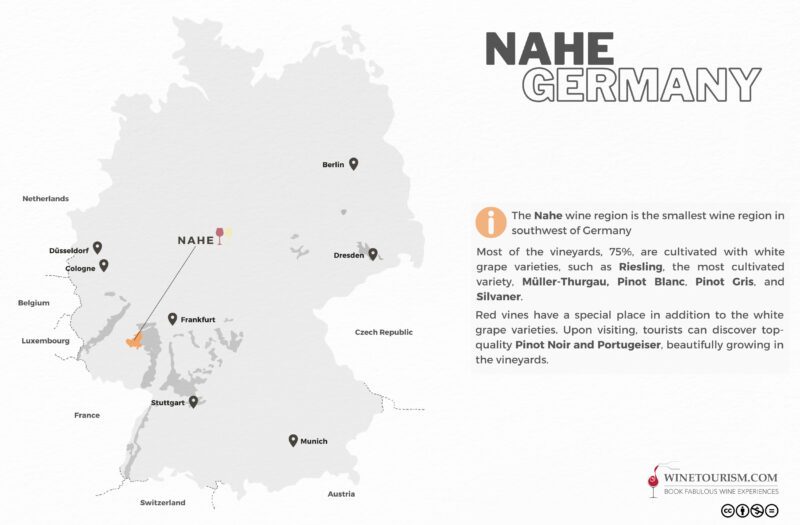
If you are looking for a free Nahe wine region map, you can download the full-size version below. Nahe is one of Germany’s most underrated wine regions, known for aromatic white wines, diverse soils, scenic vineyard views, and a wine identity that sits between some of the country’s most famous areas.
Download the full-size Nahe wine region map here
Key takeaways
- Nahe is one of Germany’s lesser-known but highly regarded wine regions.
- The region is especially known for white wines, with Riesling leading the way.
- Nahe stands out for its diverse soils and distinctive microclimates.
- The wines are often aromatic, fresh, and shaped strongly by site.
- You can download a free high-resolution Nahe wine map from the link above.
Table of contents
- Download the map
- Why Nahe matters
- What the region is known for
- Why the region stands out
- Why this map is useful
Download the map
This page gives you access to a free, detailed, high-resolution wine map of the Nahe wine region in Germany. It is useful if you are planning a wine trip, learning German wine geography, or building a clearer overview of a region that often gets less attention than it deserves.
Click here to open and download the full-size map
Why Nahe matters
Nahe matters because it is one of those wine regions that rewards people who look beyond the biggest names first. It may sit in the shadow of more internationally famous German regions, but that often works in its favor. The region has a strong identity, serious quality, and a more understated reputation that appeals to readers who want to discover something beyond the obvious.
It also matters because it helps explain the diversity of German wine. Germany is often simplified too much, with attention focused on only a handful of regions or one single style. Nahe pushes against that oversimplification. It shows how varied German wine can be, especially when geology, slope, climate, and grape choice all come together in a relatively compact area.
Nahe also matters because of its position. Located between Mosel and Rheingau, it sits in a very interesting part of Germany’s wine landscape. That alone makes it worth understanding better. When you place it on a map, the region starts to feel less like a footnote and more like an important part of the bigger story.
What the region is known for
Nahe is best known for its exceptional white wines, especially Riesling. That is the clearest entry point into the region. Riesling is the grape many readers will associate with German quality, and Nahe offers a style that can feel both expressive and precise, depending on where in the region the wine comes from.
The region is also known for its unique microclimate. That matters because climate in Nahe is not just a background detail. It helps shape the freshness, ripeness, and aromatic detail in the wines. The region has enough variation to produce wines with real site character, which is one reason it attracts drinkers who care about nuance.
Another major part of Nahe’s identity is its diverse soils. This is one of the most important reasons the region stands out. Soil diversity often leads to stylistic variety, and Nahe is a strong example of that. Even within a relatively small area, the wines can show noticeably different expressions depending on where the grapes are grown.
Scenic vineyards are another part of what Nahe is known for. The region is visually appealing in a way that makes it attractive not only to wine buyers, but also to travelers. That mix of beauty and substance helps explain why it has such loyal supporters.
Why the region stands out
Nahe stands out because it combines high quality with a slightly lower profile. That often makes a region especially appealing to people who are tired of hearing only the same headline names over and over. It feels a little more like a discovery, even though it has been respected by serious wine drinkers for a long time.
The region also stands out because it offers variety without losing coherence. Some wine regions are diverse but hard to define. Nahe manages to be diverse while still feeling recognisable. You can get aromatic, site-driven, elegant white wines that clearly belong to the broader German tradition, while still showing a distinct regional personality.
Its location between Mosel and Rheingau also helps it stand out. That position makes it easier to understand why Nahe can feel like a bridge between different expressions of German wine. It is not a copy of either region. It has its own tone, but its placement helps explain why the wines can feel both classic and distinctive.
Nahe also stands out because it is visually and intellectually rewarding. It is the kind of region that becomes more interesting the more closely you look at it. For readers who enjoy maps, regional wine styles, and the connection between place and flavour, Nahe has a lot to offer.
Why this map is useful
A Nahe wine region map is useful because it makes the region easier to place, both geographically and mentally. Many readers may have heard the name without being able to point to it on a map or explain how it fits into Germany’s wider wine picture. A visual overview fixes that quickly.
It is also useful because Nahe is a region where diversity matters. Once you understand that the area has varied soils and site conditions, the value of a map becomes much clearer. The map helps turn general knowledge into something concrete. Instead of just knowing that Nahe is important, you can start to understand where and why.
This map is also helpful for travel planning. Nahe is scenic enough to attract visitors beyond the most hardcore wine audience, and the region’s vineyard landscapes are part of the appeal. If someone is planning a broader Germany wine trip, Nahe deserves consideration, and a map makes that planning much easier.
If you are collecting wine maps, studying German wine regions, or building educational content, Nahe is a worthwhile addition. It may not always be the loudest name internationally, but it is one of the more interesting regions once you start paying attention.
See also our Wine Travel Ideas for Germany.
Wine map kindly provided by WineTourism.com.
Read next
Last updated: