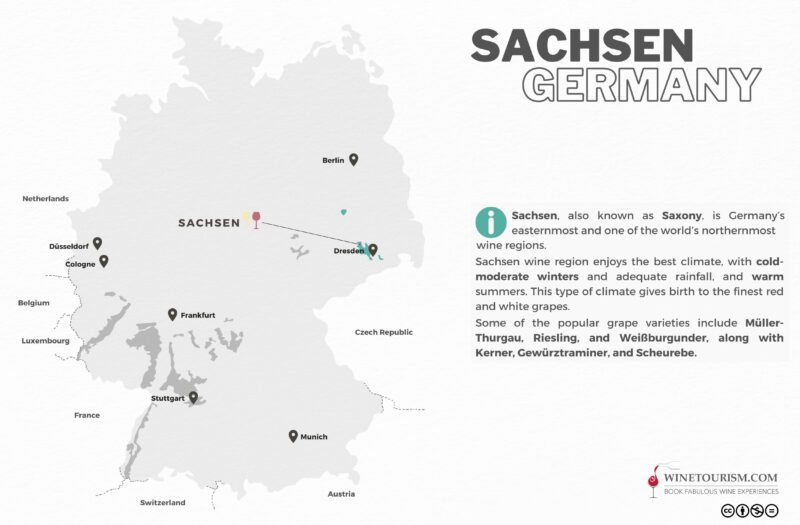
If you are looking for a free Sachsen wine region map, you can download the full-size version below. Sachsen is one of Germany’s most historic and distinctive wine regions, known for its long wine tradition, scenic vineyard landscapes, and elegant cool-climate wines.
Download the full-size Sachsen wine region map here
Key takeaways
- Sachsen is one of Germany’s oldest wine regions, with a history stretching back more than 850 years.
- The region is known for scenic vineyards and a strong cool-climate wine identity.
- Sachsen is especially associated with elegant white wines, including Riesling.
- The area stands out for its historical depth and distinct regional character.
- You can download a free high-resolution Sachsen wine map from the link above.
Table of contents
- Download the map
- Why Sachsen stands out
- What the region is known for
- Landscape, climate, and style
- Wine history and identity
- Why this map is useful
Download the map
This page gives you access to a free, detailed, high-resolution wine map of the Sachsen wine region in Germany. It is useful if you want a clearer overview of the region, are comparing German wine areas, or are planning a trip through one of the country’s lesser-known but highly interesting wine destinations.
Click here to open and download the full-size map
Why Sachsen stands out
Sachsen stands out because it feels different from the German wine regions that usually dominate the conversation. It is not the largest, and it is not the most internationally famous, but it has a very strong identity. That identity comes from a combination of history, scenery, and cool-climate wine style.
It is also one of Germany’s oldest wine regions, with a wine tradition that goes back more than 850 years. That immediately gives Sachsen a different kind of weight. The region is not just a place where wine is made. It is a place where wine has long been part of the local culture and landscape.
For readers exploring German wine maps, Sachsen is especially interesting because it adds depth to the broader picture. It shows that Germany’s wine story is not limited to the best-known western regions. There is also a strong eastern wine culture, and Sachsen is one of the clearest examples of that.
What the region is known for
Sachsen is known for scenic vineyards, cool-climate wines, and a clear sense of regional character. It is often described as a hidden gem, and that label fits because the region tends to surprise people who are more familiar with names like Mosel, Rheingau, or Pfalz.
The region is especially associated with white wines, and Riesling is one of the styles that often gets attention here. Sachsen’s white wines are generally appreciated for elegance rather than sheer weight. That makes the region attractive to readers who enjoy wines with freshness, precision, and a more restrained feel.
There is also something visually memorable about Sachsen. Wine regions often become easier to remember when the setting is distinctive, and that is true here. The vineyards, slopes, and overall landscape give the region a recognisable personality that works especially well on a map page like this.
Landscape, climate, and style
Sachsen is a cool-climate wine region, and that shapes the style of its wines in an important way. Cooler growing conditions often support freshness, acidity, and finesse, and those are qualities that fit well with the way the region is commonly described.
Its scenic vineyards are also a key part of the appeal. The landscape helps define how the region is perceived, both by visitors and by readers exploring Germany’s wine geography. A region like Sachsen benefits from being seen as well as described, which is one reason a detailed wine map is useful here.
The cool-climate profile helps explain why white wines are such an important part of the regional identity. In places where ripening is more gradual, wines often retain more tension and elegance, and that can lead to styles that feel more subtle and expressive rather than broad or heavy. Sachsen fits that pattern well.
Regional character matters too. Sachsen wines are often valued not just for grape variety, but for the sense that they reflect a specific place. That feeling of place is part of what makes smaller or less globally dominant wine regions worth exploring. They often offer something more distinct than you expect.
Wine history and identity
History is a big part of why Sachsen matters. A wine region with more than 850 years of heritage carries a different kind of identity than a newer wine area. That long timeline adds credibility, but it also adds personality. Sachsen feels rooted rather than invented.
This historical depth also makes the region more interesting from a content perspective. A map page is not only about geography. It is also about helping readers connect a place to a broader wine story. Sachsen gives you both. It has a clear physical setting and a long historical context.
There is also value in showing readers that German wine is broader than the most famous names. Sachsen strengthens that wider picture. It reminds people that wine culture in Germany stretches across multiple landscapes and traditions, and that some of the most rewarding regions are not always the ones that get the most attention first.
Why this map is useful
A Sachsen wine region map is useful because the region is not always easy for readers to place immediately in the broader context of German wine. A good map helps solve that quickly. It gives visual structure to a region that may be less familiar, and it makes the geography easier to understand at a glance.
It is also useful for travel planning. If you are exploring German wine destinations in more depth, Sachsen is the sort of region that benefits from a visual overview. It helps you understand where it sits, how it compares to other regions, and why it deserves attention.
The map is helpful for wine readers too. Whether you are researching German wine regions, building internal links across wine content, or simply trying to improve your understanding of European wine geography, a focused regional map adds practical value. Sachsen is not just a side note. It is a region with its own story, and a map helps make that story easier to follow.
Because the region combines historic importance, scenic appeal, and a clear cool-climate identity, it deserves a proper visual reference. This free downloadable map does exactly that.
See also our Wine Travel Ideas for Germany.
Wine map kindly provided by WineTourism.com.
Read next
Last updated: