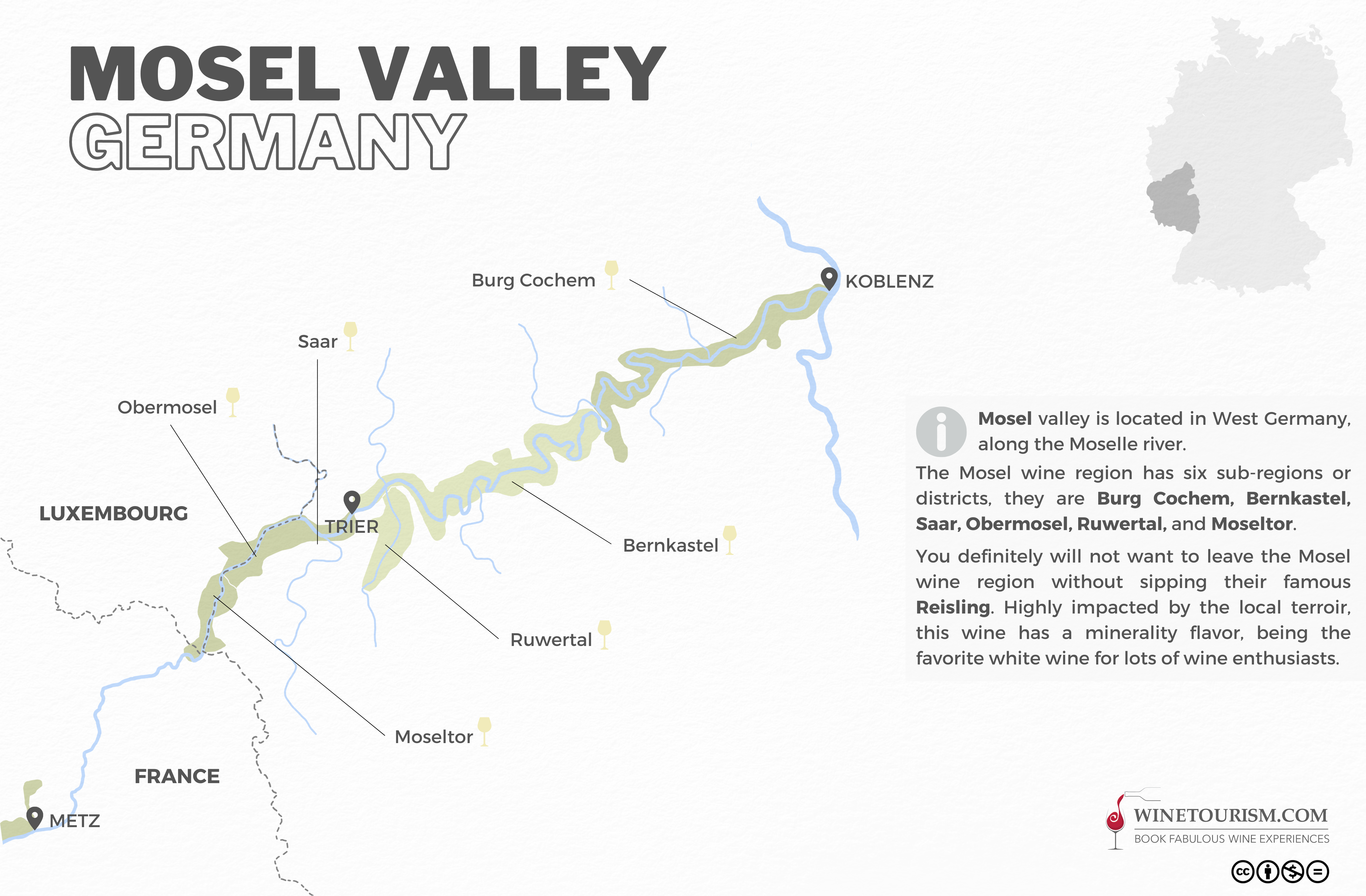
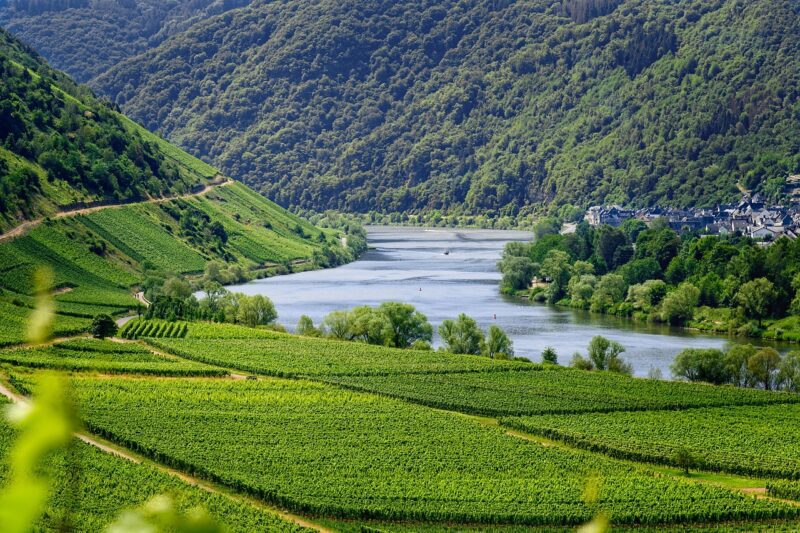
The Mosel wine region is one of the most iconic wine landscapes in Europe. With its steep terraced vineyards, winding river views, and world-famous Rieslings, Mosel has become shorthand for elegant, high-acid German wine with precision, lightness, and remarkable ageing potential. It is one of those places where the scenery is dramatic enough to grab your attention immediately, but the wines are what make the region unforgettable.
For many wine lovers, Mosel is the region that explains why Riesling is one of the world’s greatest grapes. Here, the combination of cool climate, steep slopes, slate-rich soils, and a long ripening season creates wines that can be delicate and intense at the same time. From dry and mineral to sweeter late-harvest styles, Mosel offers a range of wines that still feel unmistakably linked to one place.
Key takeaways
- The Mosel is one of Germany’s most famous and visually dramatic wine regions.
- Riesling is the dominant grape and the foundation of the region’s global reputation.
- Steep slopes, slate soils, and a cool climate are central to the style of Mosel wines.
- The region also grows Elbling, Pinot Blanc, and Pinot Gris, though Riesling remains the star.
- Villages such as Bernkastel-Kues, Piesport, and Wehlen are among the best-known names in the region.
Table of contents
- Why Mosel matters
- The history of wine in the Mosel
- Mosel terroir and growing conditions
- The main grapes of the Mosel
- How Mosel wines are made
- Famous villages and vineyards
- What Mosel wines taste like
- Why the Mosel still feels special
Why Mosel matters
The Mosel matters because it is one of the benchmark regions for cool-climate wine, especially Riesling. It is not only a famous German wine region. It is one of the places that shapes how the grape is understood globally. When people talk about tension, minerality, low alcohol, precision, and age-worthy sweetness in Riesling, Mosel is often the reference point.
It also matters because the region is so visually distinctive. The steep vineyards along the river are not just attractive. They are central to how the wines are made and why they taste the way they do. This is not a flat, easy farming landscape. It is a region where viticulture can be physically demanding, highly selective, and deeply tied to place.
For Corked News readers, Mosel is especially useful because it connects several important wine ideas at once: slope, climate, soil, grape variety, and regional history. It is one of the clearest places to see how all those factors combine into a coherent and world-class wine identity.
The history of wine in the Mosel
Winemaking in the Mosel goes back to Roman times, when the Romans recognised the region’s potential and planted vineyards along the riverbanks. That early viticultural foundation matters because it shows how long the area has been understood as suitable for wine, despite its northerly location and demanding terrain.
Over the centuries, the Mosel developed into one of Germany’s most esteemed wine regions. Monastic and aristocratic influence helped preserve and expand vineyard culture, and the region gradually built its reputation around Riesling. That reputation was not created overnight. It was shaped over generations through vineyard work, trade, and a growing recognition that the region could produce wines of unusual finesse and longevity.
Today, Mosel still feels like a place where history remains visible. The villages, vineyard layouts, and traditional cellar choices all reinforce the sense that this is one of the old centres of German wine culture. At the same time, modern producers continue refining quality through cleaner cellar work, more precise viticulture, and a stronger focus on expressing site clearly.
That balance between heritage and adaptation is one of the reasons Mosel still feels so relevant. It is not locked in the past, but it has never lost touch with it either.
Mosel terroir and growing conditions
The Mosel’s terroir is one of the most distinctive in the wine world. The region’s style depends on a combination of steep slopes, slate-rich soils, river influence, and cool-climate ripening. Each of these factors matters on its own, but it is the way they work together that makes Mosel unique.
Steep slopes
The vineyards of the Mosel are famous for their steepness, with some sites reaching gradients of around 70 degrees. That is not just dramatic to look at. It has a real viticultural purpose. These steep terraced slopes allow the vines to catch more sunlight, which is crucial in a cool and northerly region where full ripening is never something to take for granted.
The steepness also helps with drainage and creates a strong sense of exposure. But it comes at a cost. Vineyard work here is labour-intensive and often still relies on hand work rather than large-scale mechanisation. That adds to the difficulty of farming, but it also helps explain why Mosel wines can feel so site-specific and carefully made.
Slate and mineral-rich soils
Mosel is closely associated with slate, and for good reason. Slate-rich soils are a key part of the region’s identity and are often linked to the flinty, smoky, stony character that many people associate with classic Mosel Riesling. Quartzite and sandstone also appear in parts of the region, adding further variation.
Whether you call it minerality, stoniness, or something more specific, the soil influence feels unusually clear in the best wines. Mosel often produces wines where the fruit is delicate enough that the soil-derived structure and edge become especially noticeable.
Cool climate and long ripening
The Mosel’s cool climate is essential to its style. Grapes ripen slowly here, which helps preserve acidity and aromatic detail. This long ripening season is one of the reasons Mosel Rieslings can show both delicacy and complexity at the same time.
The region’s wines are often not powerful in the conventional sense. Their strength comes from clarity, balance, and precision. That is what cool-climate ripening can achieve when the sites are strong enough to bring the grapes to full flavour maturity.
River influence
The Mosel River helps moderate the climate and reflect light back toward the vineyards. In a cooler region, that moderating effect matters a great deal. It helps soften temperature extremes and supports more stable ripening conditions than the latitude alone might suggest.
This river influence is one of the reasons Mosel can produce such refined wines at all. Without it, the region would be a much more difficult place for fine viticulture.
The main grapes of the Mosel
Although several grape varieties are grown in the Mosel, one grape clearly defines the region’s reputation.
Riesling
Riesling is the undisputed star of the Mosel. The grape thrives in the region’s cool climate and slate soils, producing wines with energy, finesse, and a thrilling balance between acidity and fruit. Depending on style, Mosel Rieslings can show lime, green apple, white peach, apricot, citrus peel, floral lift, and a marked mineral edge.
What makes Riesling in the Mosel especially compelling is the way it handles sweetness. Even sweeter wines can feel lifted and precise because the acidity keeps them from becoming heavy. That balance is one of the great signatures of the region.
If you want to understand Riesling in a broader German context, it also helps to compare the Mosel with places such as Rheingau and Pfalz.
Elbling
Elbling is a traditional grape of the region and is often associated with lighter, crisp wines. It does not have the prestige of Riesling, but it remains part of the Mosel story, especially in simple table wines and sparkling wine production.
Pinot Blanc and Pinot Gris
Pinot Blanc and Pinot Gris also appear in the Mosel and can produce aromatic, expressive wines. They are not the focus of the region’s identity, but they do show that the Mosel is not entirely a one-grape landscape.
How Mosel wines are made
The Mosel’s winemaking traditions are built around precision and restraint. The aim is usually to preserve rather than overwork what the vineyard has given. That approach suits a region where delicacy, acidity, and site expression matter so much.
Selective hand harvesting
Because of the steep slopes, hand harvesting is often essential. But even beyond logistics, selective hand picking helps ensure that only the best fruit enters the cellar. This matters especially in a region where ripeness levels can vary from bunch to bunch and where sweeter styles may require very careful selection.
Slow fermentation
Many Mosel winemakers favour slow, cool fermentations to preserve aromatic clarity and freshness. That helps Riesling hold onto its lifted citrus, floral, and orchard-fruit profile rather than becoming broad or overly developed too early.
Stainless steel ageing
Stainless steel is widely used because it preserves purity and precision. In a region where freshness and mineral expression are such important parts of the final style, this makes sense. Oak is generally less central here than in some other wine regions, although some producers may still use larger neutral vessels or other approaches depending on style.
The broader philosophy is clear: do not bury the vineyard character. Let the wine stay transparent to place.
Famous villages and vineyards
The Mosel is full of famous names, but a few stand out especially strongly for wine lovers.
Bernkastel-Kues
Bernkastel-Kues is one of the most picturesque villages in the region and one of the names most closely associated with classic Mosel wine culture. Its half-timbered houses and river setting make it a strong travel destination, but it also matters because it sits at the heart of some of the region’s best Riesling production.
Piesport
Piesport is home to the famous Piesporter Goldtröpfchen vineyard, one of the region’s classic sites. The wines from here are often known for their concentration, structure, and ageing potential, making the village especially important for readers who want to understand the serious side of Mosel Riesling.
Wehlen
Wehlen, and especially the Wehlener Sonnenuhr vineyard, is another landmark name in the region. The steep vineyard slopes and reputation for exceptional Riesling make it one of the signature places in the Mosel story.
For readers exploring the travel side too, our Germany wine trip travel ideas guide and our Mosel wine map are good next steps.
What Mosel wines taste like
Mosel Rieslings often show a remarkable combination of lightness and intensity. At first glance, they can seem delicate, but that delicacy hides a lot of detail. Citrus, green apple, white peach, apricot, floral notes, and a stony or smoky mineral edge are all common. The best examples often feel very pure and very precise.
One of the region’s defining strengths is the balance between acidity and sweetness. Dry wines can feel sharp, energetic, and mineral. Off-dry or sweeter wines can feel lush and expressive, but the acidity keeps them alive. That is the key. Even when the wine has sweetness, it does not usually feel lazy or heavy.
This combination is one reason Mosel has such a loyal following among wine enthusiasts. The wines often feel both easy to drink and endlessly interesting to think about.
Why the Mosel still feels special
The Mosel still feels special because few wine regions combine natural beauty, historical depth, and such a clear grape identity in quite the same way. It is a place where the landscape is not just scenic background. It is visibly tied to the difficulty and quality of the wines.
It also remains essential because Riesling remains essential. As more wine drinkers rediscover freshness, lower alcohol, food-friendliness, and site transparency, the Mosel feels more relevant than ever. Its wines show that elegance does not need to come from weight, and that some of the most memorable wines in the world can come from delicacy, acidity, and patience.
Whether you prefer a bone-dry Riesling, a beautifully balanced Kabinett, or a richer late-harvest wine, the Mosel offers one of the most complete expressions of cool-climate wine anywhere. That is why it continues to capture the imagination of wine lovers around the world.
See our article on planning a wine trip to Germany for inspiration on more German wine destinations.
Read next
Last updated: