
Puglia is one of Italy’s most characterful wine regions, yet it still feels underrated compared with Tuscany, Piedmont, or Veneto. Sitting in the heel of Italy’s boot, this long sunlit region combines ancient winemaking roots, native grape varieties, Mediterranean warmth, and a growing quality focus that has made it far more interesting than the old stereotypes of bulk southern wine suggest.
For wine lovers, that is exactly what makes Puglia worth paying attention to. It offers bold reds, distinctive local grapes, a strong sense of place, and enough diversity to keep exploring. You can find rich Primitivo, structured Nero di Troia, dark and slightly bitter Negroamaro, and increasingly impressive whites too. The best wines of the region feel unmistakably southern Italian, but they also show freshness, balance, and regional identity.
In this guide, we take a closer look at the history of the Puglia wine region, its terroir and climate, the main grapes that define it, the winemaking techniques that shape its wines, and the appellations that matter most.
Key takeaways
- Puglia is one of Southern Italy’s most important wine regions, with a history of viticulture stretching back more than 2,000 years.
- The region’s Mediterranean climate, strong sunshine, and sea influence help produce ripe, expressive wines.
- Primitivo, Negroamaro, Nero di Troia, and Fiano are some of the grapes most strongly associated with Puglia.
- Puglia combines traditional methods with more modern quality-minded winemaking.
- Key appellations include Salento, Castel del Monte, and Gioia del Colle.
Table of contents
- Why Puglia matters
- The history of wine in Puglia
- Puglia’s terroir and growing conditions
- The main grape varieties of Puglia
- Winemaking in Puglia: tradition and modern style
- The most important Puglia appellations
- What Puglia wines taste like
- Why Puglia is worth exploring today
Why Puglia matters
Puglia matters because it offers a side of Italian wine that feels both traditional and increasingly modern at the same time. It has deep roots, local grapes, and a strong agricultural identity, but it is no longer only a region associated with quantity. More producers now focus on lower yields, old-vine fruit, better vineyard work, and a clearer expression of place.
That shift has helped the region gain more respect internationally. Instead of being seen only as a warm-climate source of powerful reds, Puglia is now better understood as a large and varied wine region with several serious appellations and a strong native grape culture.
It also matters because it broadens the picture of Italian wine. Many wine drinkers start with the north or with the most internationally famous names. Puglia reminds them that Southern Italy has its own equally compelling wine story, shaped by sunshine, sea influence, old vineyards, and centuries of exchange across the Mediterranean.
For Corked News readers, Puglia is especially interesting because it works on several levels at once. It is useful for regional wine learning, for travel planning, for grape exploration, and for understanding how climate and place influence style in Southern Italy.
The history of wine in Puglia
The winemaking tradition in Puglia stretches back more than two millennia. The ancient Greeks are often credited with introducing viticulture to the region in the 7th century BC, and from there wine became part of the area’s agricultural and cultural identity.
Puglia’s location mattered enormously. Sitting along key Mediterranean routes, it became a place where people, goods, and ideas passed through. That meant grape material, farming practices, and winemaking knowledge could move in and out of the region more easily than in more isolated inland areas. Over centuries, this helped create a diverse and adaptable wine culture.
Like many parts of Italy, Puglia also felt the influence of later civilisations and powers that shaped the peninsula. Trade, agriculture, and regional development all left their mark. The result is a wine region with a very old foundation, but one that never developed in isolation. That openness helps explain why Puglia can feel both deeply local and broadly Mediterranean at the same time.
For much of the modern era, Puglia was strongly associated with volume. It produced large amounts of ripe southern wine, often used to add colour, body, or alcohol to wines from elsewhere. But that is only part of the story. The quality potential was always there, especially in old vineyards and local grape varieties. What has changed more recently is the willingness to foreground that potential instead of hiding it behind volume production.
Puglia’s terroir and growing conditions
Puglia’s terroir begins with sunshine. This is a warm Mediterranean region with hot summers, mild winters, and a long growing season. That gives grapes plenty of opportunity to ripen fully, which is why so many Puglian wines show generous fruit, soft texture, and warmth on the palate.
But sunshine alone does not define the region. Sea influence matters too. Puglia is surrounded by water on multiple sides, and those coastal breezes help moderate extreme heat and preserve freshness in the grapes. In a hot southern region, that is crucial. Without that movement of air, the wines could easily become flatter or more overripe than they are.
Climate
The Mediterranean climate is one of the core reasons the region works so well for viticulture. Hot, dry summers reduce disease pressure and help grapes reach full maturity. Mild winters keep the growing cycle relatively stable. This overall pattern is especially well suited to red varieties such as Primitivo, Negroamaro, and Nero di Troia, all of which thrive in warmth.
Still, the best wines are not simply “ripe because it is hot.” They are balanced because the region also benefits from air flow, site differences, and careful vineyard management. That is what separates serious Puglian wine from simple warm-climate wine.
Soils
Puglia’s soils vary more than some outsiders expect. In the north, limestone and clay play an important role, while in the south you find sandy loam, red earth, and other soil types that shape how the vines grow and how the wines express themselves.
Limestone can contribute structure and tension. Clay can retain moisture and help vines through drier periods. Sandier soils can influence freshness and drainage. These differences matter because they give the region more internal variation than a simple “hot south” stereotype suggests.
Sunshine and coastal breezes
The combination of abundant sunlight and sea breeze is one of Puglia’s great strengths. The sunshine helps ripen grapes fully, while the breezes can slow stress, protect freshness, and support healthier vineyard conditions. This mix is a big reason why the best wines show both concentration and life rather than just power.
Irrigation and dry conditions
Puglia can be dry and arid, especially in hotter zones, so water management matters. Some vineyards rely on irrigation to support vine growth and maintain yields. That practical reality is part of viticulture in a warm southern region, and it shows how growers adapt the old traditions of the region to modern climate conditions.
The main grape varieties of Puglia
Puglia’s identity is strongly tied to its grape varieties. This is one of the region’s biggest strengths. Rather than relying mainly on international grapes, Puglia still expresses itself through local and historically rooted varieties that feel deeply connected to the land.
Primitivo
Primitivo is probably the most internationally recognised grape from Puglia. It produces rich, full-bodied red wines with dark fruit, spice, warmth, and a generous texture that makes it immediately appealing to many drinkers.
At its best, Primitivo offers much more than power. Good examples can also show freshness, structure, and regional nuance, especially from stronger sites such as Gioia del Colle. This matters because Primitivo is often misunderstood as simply a big, fruity southern grape. In reality, it can produce wines with far more finesse than that reputation suggests.
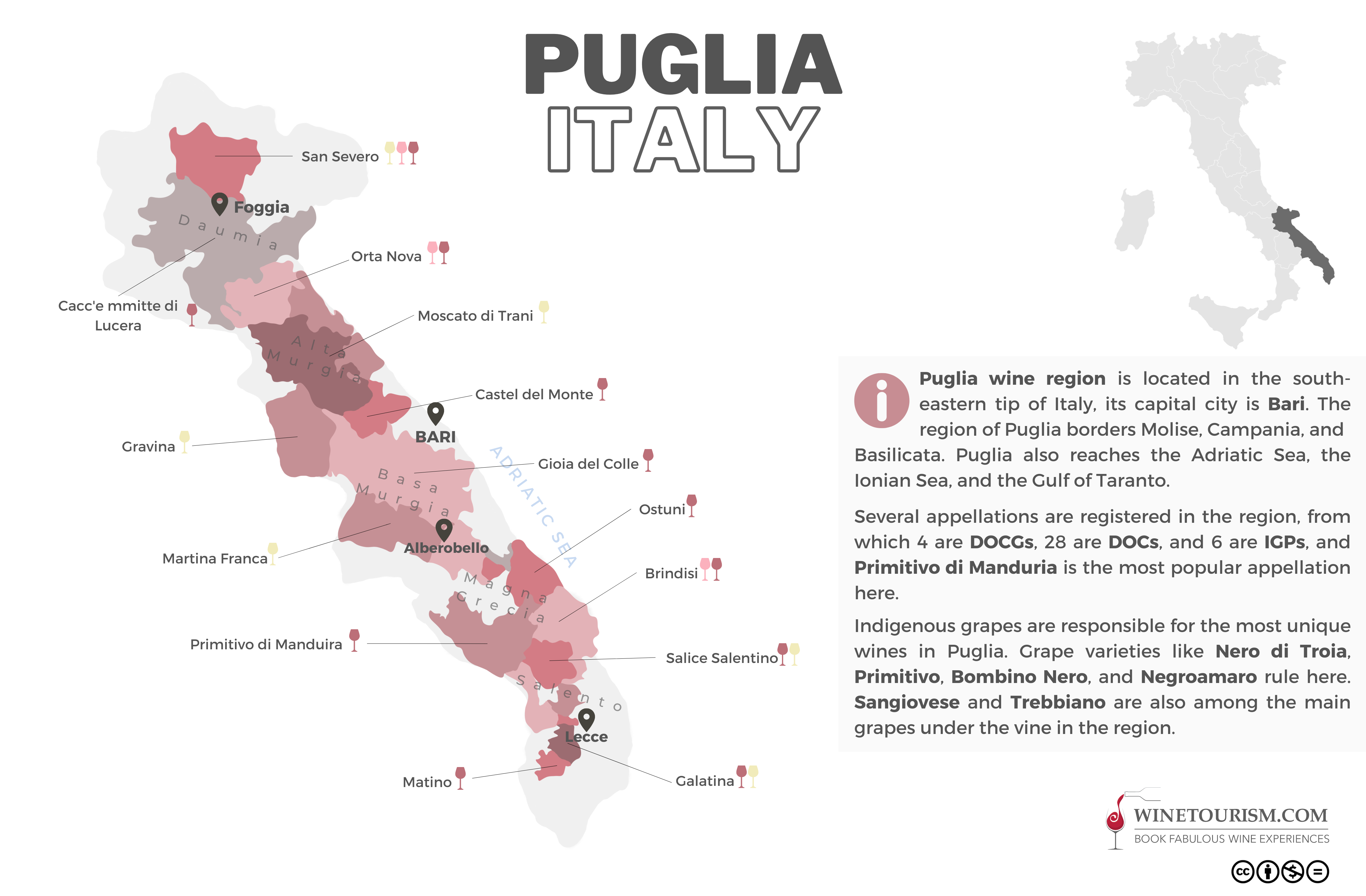
For readers interested in the broader region, our Puglia wine region map is a useful follow-up.
Negroamaro
Negroamaro is another essential grape of the region and one that often gives Puglia a darker, more savoury personality. The wines can show plum, blackberry, herbs, earth, and the slight bitter edge that makes the grape distinctive. That bitterness is part of the appeal rather than a flaw, especially when balanced by ripe fruit and warmth.
Negroamaro often feels more rooted and regional than international in style. It is one of the grapes that gives southern Puglia, especially Salento, such a recognisable identity.
Nero di Troia
Nero di Troia, also known as Uva di Troia, is particularly important in northern parts of Puglia and in appellations such as Castel del Monte. It tends to produce wines with deeper colour, a firmer structure, and a strong balance between fruit and tannin.
Compared with Primitivo, Nero di Troia can feel more restrained and more structured. That makes it especially interesting for drinkers who want Southern Italian wine with substance and character, but not necessarily the fullest, ripest style.
Fiano
Among white grapes, Fiano stands out. It produces aromatic wines with citrus, floral notes, herbs, and often a fresh but rounded texture. In Puglia, Fiano shows that the region is not only about bold reds. It can also produce whites with energy, perfume, and food-friendly character.
This adds another layer to the region’s identity and makes it more interesting as a travel and wine-learning destination.
Winemaking in Puglia: tradition and modern style
Puglia’s winemaking today reflects a mix of tradition and adaptation. Ancient vineyard culture still matters here, but producers increasingly work with modern cellar precision and stronger quality ambitions.
Extended maceration
For some red wines, extended maceration is used to extract more colour, tannin, and flavour from the skins. This can create more structured and powerful wines, especially with grapes such as Negroamaro and Nero di Troia. In a region already associated with ripe fruit, this technique can push wines toward greater depth and seriousness when used well.
Appassimento
Some areas of Puglia also use appassimento, where grapes are partially dried before fermentation. This concentrates sugar and flavour, leading to richer, fuller wines. While appassimento is most famously associated with Veneto, its use in Puglia shows how southern producers can adapt drying methods to create powerful wines with extra texture and complexity.
Oak ageing
Oak ageing is common in many red wines, especially when producers want to add spice, softness, and more layered development. The best wines use oak to support the fruit rather than smother it. When done well, it adds depth and makes the wine feel more complete. When overdone, it can flatten the grape’s regional identity. The stronger producers in Puglia increasingly understand that balance.
What makes modern Puglia especially interesting is that the region now has more producers trying to express grape and place clearly rather than simply aiming for bigness. That shift is one of the most important developments in the region today.
The most important Puglia appellations
Puglia includes several appellations that help define the region’s best expressions. Three stand out in particular.
Salento
Salento, in the southernmost part of Puglia, is one of the names most closely tied to the warm and generous side of the region’s identity. It is especially important for Primitivo and Negroamaro. Wines from here often show ripeness, fruit depth, warmth, and an unmistakably Mediterranean feel.
Salento helps define the image of Puglia for many wine drinkers because it captures the region’s sun-driven, expressive style so clearly.
Castel del Monte
Castel del Monte, named after the famous medieval castle in the area, is particularly important for Nero di Troia. This appellation is often associated with more structured, elegant, and age-worthy wines, giving northern Puglia a slightly different profile from the broader warm richness of the south.
For drinkers who want to see the more serious, architectural side of Puglia, Castel del Monte is a very good place to start.
Gioia del Colle
Gioia del Colle is especially significant for Primitivo. What makes it stand out is the combination of altitude and cooler temperatures compared with hotter lower zones. That can help the wines retain more acidity and finesse, showing that Primitivo is capable of more than just richness and fruit weight.
This appellation is one of the clearest examples of how site matters inside Puglia and why the region should not be treated as one broad, uniform wine landscape.
What Puglia wines taste like
Puglia wines often taste generous, ripe, and sun-shaped, but the best examples also carry more balance than many people expect. Primitivo can bring dark berry fruit, plum, spice, and a soft, full texture. Negroamaro often adds darker tones, herbs, and a slightly bitter edge that keeps things interesting. Nero di Troia can feel firmer, more structured, and a little more restrained. Fiano offers citrus, flowers, and a lighter, fresher contrast.
That range is important because it shows the region is not defined by one taste profile alone. Puglia can produce easy, fruit-forward wines for immediate drinking, but it can also produce more layered bottles that reward attention and food pairing.
For readers interested in visiting, our Italy wine trip travel ideas guide is a useful companion to this regional overview.
Why Puglia is worth exploring today
Puglia is worth exploring because it combines history, local identity, and a changing quality story in one region. It is no longer enough to describe it simply as a hot southern wine zone. That misses the real appeal.
This is a region where ancient vineyard culture still matters, where local grapes still drive identity, and where better producers are showing more clearly what the land can do. It is also a region that feels emotionally easy to connect with. The wines are warm, expressive, Mediterranean, and tied closely to food, place, and lifestyle.
For wine drinkers, Puglia offers a very appealing mix of familiarity and discovery. The wines are generous enough to be immediately enjoyable, but the region is deep enough to reward serious exploration. That is a strong combination, and it is a big reason why Puglia keeps growing in reputation.
Raise a glass to Puglia and you are not just tasting a southern Italian wine region. You are tasting one of the most historically rooted and increasingly compelling parts of modern Italian wine.
See our article on planning a wine trip to Italy for inspiration on more Italy wine destinations.
Read next
Last updated: