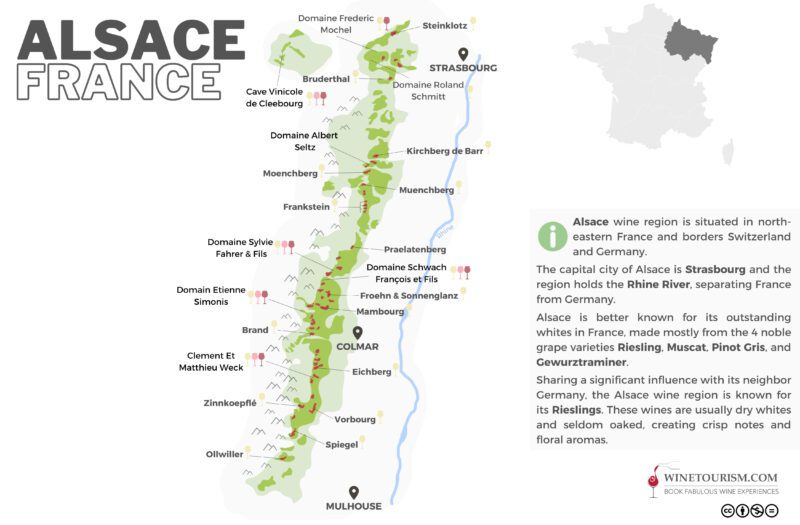
If you are looking for a free Alsace wine region map, you can download the full-size version below. Alsace is one of France’s most distinctive wine regions, known for aromatic white wines, picturesque vineyard villages, and a strong regional identity shaped by both French and German influence.
Download the full-size Alsace wine region map here
Key takeaways
- Alsace is one of France’s best-known white wine regions.
- The area is especially associated with Riesling, Gewürztraminer, and Pinot Gris.
- Its location between the Vosges Mountains and the Rhine helps shape a distinctive wine style.
- Alsace wines are often known for purity, aromatic intensity, and mineral character.
- You can download a free high-resolution Alsace wine map from the link above.
Table of contents
- Download the map
- Why Alsace stands out
- What the region is known for
- Climate, soils, and landscape
- Wine style and regional identity
- Why this map is useful
Download the map
This page gives you access to a free, detailed, high-resolution wine map of the Alsace wine region in France. It is useful if you want a clearer overview of one of the country’s most recognisable white wine areas, whether for wine education, trip planning, or general research.
Click here to open and download the full-size map
Why Alsace stands out
Alsace stands out because it feels different from almost every other French wine region. It has a very clear identity, both visually and stylistically. The region is especially known for white wines, and many of those wines are bottled in a way and labelled in a style that makes them instantly recognisable.
It is also one of those regions that readers tend to remember easily because the wines, grapes, and geography all connect clearly. When people think of Alsace, they often think of aromatic whites, charming villages, long vineyard stretches, and the strong influence of place. That makes it a great region for a dedicated wine map page.
The area’s position in northeastern France also matters. Alsace sits in a part of Europe where geography and history have shaped wine culture in a very distinctive way. That combination of location, tradition, and grape identity gives the region a stronger personality than many broader wine areas.
What the region is known for
Alsace is renowned for exceptional white wines, and a few grape varieties define that reputation more than any others. Riesling, Gewürztraminer, and Pinot Gris are among the names most closely associated with the region, and they help explain why Alsace has such a strong identity among wine lovers.
Riesling from Alsace is often admired for its structure, freshness, and mineral edge. Gewürztraminer tends to be associated with aromatic intensity and exotic spice. Pinot Gris brings more texture and richness. Together, those varieties give Alsace a broad but still very coherent wine profile.
The region is also known for wines that combine elegance with clarity. Even when the wines are expressive and aromatic, they often feel precise rather than heavy. That balance is one of the things that gives Alsace such a strong following among readers who enjoy white wines with personality and sense of place.
Climate, soils, and landscape
Alsace lies between the Vosges Mountains and the Rhine River, and that setting is central to the region’s wine identity. Geography here is not just background. It actively shapes the conditions that help the vineyards produce distinctive wines.
The region’s microclimate is one of the reasons Alsace is so well suited to high-quality white wine production. Shelter from the mountains, combined with favourable vineyard sites, supports ripening while still helping the wines retain freshness and definition. That balance is especially important for grapes like Riesling and Pinot Gris.
Soils also play a major role. Alsace is often described as having rich and varied soils, and those differences contribute to the diversity within the region. Mineral notes in Alsace wines are frequently part of how the wines are described, and that sense of minerality is one reason the region continues to stand out in the wider white wine conversation.
The landscape adds another layer of appeal. Alsace is visually memorable, with vineyard slopes, half-timbered villages, and a wine route that has become well known far beyond France. A map helps tie that scenery together with the wine geography in a way plain text cannot always do on its own.
Wine style and regional identity
Alsace has one of the clearest regional wine identities in Europe. That is partly because the wines are often varietal and partly because the region’s style feels so consistent in quality and direction. Even when the grapes differ, the wines often share a sense of focus, aromatic detail, and freshness.
Another reason the region stands out is that its wines often express both fruit and minerality in a very direct way. Readers looking for wines with strong varietal character often end up drawn to Alsace because the styles are easier to connect to specific grapes than in many blend-driven regions.
The elegance of the wines is another recurring theme. Alsace whites are often described as vibrant rather than broad, expressive rather than excessive. That makes the region appealing to both newer wine drinkers and more experienced readers who want precision as well as flavour.
Alsace also works especially well in educational wine content because it is easy to explain and rewarding to explore in more detail. A wine map helps that process by giving readers a visual anchor for the grapes, the region, and the broader French wine landscape.
Why this map is useful
An Alsace wine region map is useful because the area has such a strong internal identity that it benefits from a clear visual overview. Readers often know the name Alsace and may recognise the grape varieties, but a map helps connect those ideas to an actual place.
That makes the map valuable for trip planning, for wine study, and for readers comparing French wine regions. Alsace may be compact compared to some other parts of France, but it has enough history, regional character, and stylistic importance to justify its own dedicated map page.
The map is also practical because Alsace often serves as an entry point into French white wine. Readers interested in Riesling, Gewürztraminer, Pinot Gris, or mineral-driven whites can use the map as a starting point for understanding where those wines come from and why the region matters.
For Corked News, pages like this also support broader internal linking across wine maps, wine travel, and wine region content. Alsace is one of those regions that naturally fits into all three. It is educational, travel-friendly, and strongly tied to grape-specific search intent.
See also our Wine Travel Ideas for France.
Wine map kindly provided by WineTourism.com.
Read next
Last updated: