
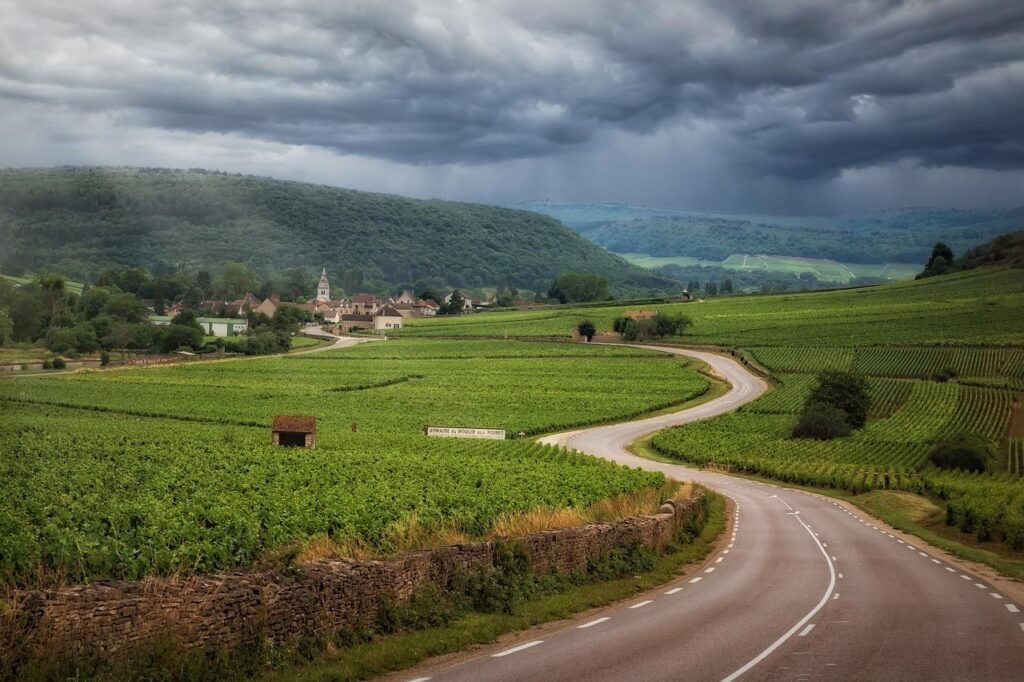
Côte d’Or is the most famous stretch of vineyard land in Burgundy and, for many wine lovers, the part of France where terroir becomes easiest to understand in real terms. This narrow escarpment is home to some of the world’s most sought-after Pinot Noir and Chardonnay, but the real fascination of Côte d’Or is not just prestige. It is the way tiny differences in slope, soil, exposure, and village identity can produce wines with clearly different personalities.
That is why Côte d’Or matters so much. It is the heart of Burgundy, split into two halves that each tell a slightly different story. Côte de Nuits is best known for profound red wines from Pinot Noir, while Côte de Beaune is celebrated above all for Chardonnay, even though it also makes excellent reds. Together they form one of the most important fine wine landscapes anywhere.
If you are trying to understand Burgundy beyond the headline names, Côte d’Or is the place to focus. It gives you the clearest look at why Burgundy is so obsessed with vineyard hierarchy, village identity, and site expression, and why collectors talk about this strip of land with near-religious intensity.
Key takeaways
- Côte d’Or is the most prestigious core of Burgundy, divided into Côte de Nuits and Côte de Beaune.
- Côte de Nuits is most famous for Pinot Noir, while Côte de Beaune is especially famous for Chardonnay, though both make red and white wine.
- The region’s limestone-rich soils, cool climate, and detailed vineyard hierarchy help explain why Côte d’Or wines are so revered.
Table of contents
- Why Côte d’Or matters
- Côte de Nuits and its great red wines
- Côte de Beaune and its famous whites
- Terroir and climate in Côte d’Or
- Grand Cru, Premier Cru, and village hierarchy
- Grapes and winemaking traditions
- Food, travel, and the culture of Côte d’Or
- Why Côte d’Or stays at the center of fine wine
Why Côte d’Or matters
Côte d’Or is often described as the soul of Burgundy, and that is not just marketing language. This is the strip of vineyard land where many of Burgundy’s most prized sites sit, from Gevrey-Chambertin and Vosne-Romanée in the north to Meursault, Puligny-Montrachet, and Chassagne-Montrachet further south. If you care about fine Pinot Noir or Chardonnay, you end up here sooner or later.
The region is also one of the clearest examples of why Burgundy can feel both magical and maddening. The distances are short, the grape set is relatively simple, and yet the variation in style is enormous. A wine from Volnay does not feel like one from Pommard. A white from Puligny-Montrachet does not feel like one from Meursault. That level of detail is what makes Côte d’Or so compelling once you start paying attention.
If you want the bigger background first, Bordeaux vs Burgundy: How Burgundy Surpassed Bordeaux in Popularity helps explain why Burgundy, and by extension Côte d’Or, carries so much weight in the wine world today.
Côte de Nuits and its great red wines
Côte de Nuits is the northern half of Côte d’Or, and it is where Burgundy’s red wine reputation reaches its highest and most expensive expression. This is Pinot Noir country in the most famous sense. Villages such as Gevrey-Chambertin, Chambolle-Musigny, Morey-Saint-Denis, Vosne-Romanée, and Nuits-Saint-Georges all sit here, each with its own identity and fan base.
The appeal of Côte de Nuits is not simply that it makes powerful Pinot Noir. In fact, power is rarely the point. The best wines combine fragrance, structure, texture, and depth in ways that feel unusually complete. Some villages lean more muscular and dark, others more floral and silky, others more spice-driven and refined. That is what keeps people fascinated by them.
This is also where some of Burgundy’s most legendary Grand Crus are found, including Romanée-Conti, La Tâche, Richebourg, Chambertin, and Clos de Vougeot. Not every bottle from these sites is automatically transcendent, but the vineyards themselves are among the most famous in the world for a reason.
For the grape itself, Pinot Noir / Spätburgunder Red Wine Grape is the most relevant internal read alongside this section.
Côte de Beaune and its famous whites
Côte de Beaune is the southern half of Côte d’Or, and it is best known for some of the greatest Chardonnay in the world. Villages such as Meursault, Puligny-Montrachet, Chassagne-Montrachet, and Corton-Charlemagne have shaped the global image of fine white Burgundy. These are wines prized for their texture, precision, layered fruit, mineral backbone, and ability to age.
But it would be a mistake to reduce Côte de Beaune to white wine alone. It also produces some outstanding reds, especially from Beaune, Volnay, and Pommard. Volnay is often associated with elegance and perfume, while Pommard has long had a reputation for greater structure and firmness, though real bottles can be more nuanced than those old clichés suggest.
What makes Côte de Beaune so interesting is that it does both worlds well. It gives you some of the most sought-after Chardonnay on earth, while still holding a serious red wine identity. That dual strength is part of why the region feels so central to Burgundy as a whole.
For the white grape side of the story, Chardonnay White Wine Grape: From Chablis to California is the strongest internal follow-up.
Terroir and climate in Côte d’Or
Côte d’Or’s terroir is one of the main reasons the wines command such attention. Limestone and marl dominate the geological picture, though there is plenty of variation within that broad description. Limestone helps with drainage and is strongly tied to the mineral precision so many growers talk about, while marl and clay can influence texture, water retention, and overall vine behavior.
The slope matters just as much as the soil. In Côte d’Or, the best vineyards often sit in a kind of sweet spot on the incline, not too high and not too low, with good sun exposure and enough drainage to avoid excessive water stress or stagnant conditions. The vineyards below may be richer or heavier. The ones above may be cooler or thinner. Those small shifts matter enormously here.
The climate is broadly continental, with warm summers, cold winters, and real growing-season risks such as frost, hail, and uneven ripening. Côte d’Or is not an easy place to grow grapes. That challenge is part of why good vineyards and good producers matter so much. In a forgiving region, the difference between great and average sites can be blurred. In Burgundy, it rarely is.
This is exactly why The Exciting Impact of Terroir on Wine fits so naturally here. Côte d’Or is one of the best examples in the world of terroir being more than just a romantic talking point.
Grand Cru, Premier Cru, and village hierarchy
One of the reasons Côte d’Or can be confusing at first is that the classification system matters so much. Burgundy does not work like a simple brand hierarchy. Place is the structure. The most important tiers in Côte d’Or are village wines, Premier Cru, and Grand Cru, with regional Bourgogne wines sitting below them.
Grand Cru is the top level and includes the most prestigious vineyard sites, many of them within Côte d’Or. These are the names that carry huge prestige and often huge prices. Below that, Premier Cru designates high-quality vineyard sites within a village, while village wines carry the name of the commune but not a top vineyard classification.
The hierarchy is useful, but it is not everything. A brilliant village wine from a top producer can be more exciting than an underperforming higher-tier bottle. Burgundy lovers know this well. Even so, classification remains one of the most important ways to understand how Côte d’Or is organized and why certain wines receive so much attention.
Grapes and winemaking traditions
Côte d’Or may be famous for terroir, but grape choice still matters. Pinot Noir dominates the reds, and Chardonnay dominates the whites. That relative simplicity is part of what makes the region such a pure expression of site. Producers are not juggling huge numbers of varieties. They are working deeply with two grapes that are especially sensitive to climate and place.
Winemaking traditions in Côte d’Or are often associated with small domaines, careful vineyard work, and a relatively restrained cellar philosophy. Many producers talk about minimal intervention, but that can mean different things in practice. Some use more whole cluster fermentation, some less. Some favor more new oak, some less. Some lean into native fermentations. Others are more controlled. The point is not that every producer works identically. The point is that the regional ideal usually favors purity and site expression over heavy manipulation.
That makes Côte d’Or a natural companion to How Wine Is Made: A Clear Guide to Vineyard, Fermentation, Aging, and Bottling. The region shows very clearly how vineyard and cellar decisions interact, but also why the vineyard usually remains the main voice.
Food, travel, and the culture of Côte d’Or
Côte d’Or is not just a collector’s fantasy. It is also a deeply gastronomic region. Burgundy’s wines were made to sit at the table, and the local cuisine proves the point. Coq au vin, boeuf bourguignon, escargots, roast poultry, mushroom dishes, and rich cheeses all make sense in the context of Côte d’Or wines.
Red Burgundy from Côte de Nuits or Côte de Beaune can be superb with poultry, duck, veal, mushroom dishes, and classic French cooking. White Burgundy from villages like Meursault or Puligny-Montrachet is brilliant with lobster, richer fish dishes, poultry in cream sauce, and many cheese-based preparations. These are not flashy pairings. They are deep, natural, and satisfying ones.
If you want to build out that side, Food and Wine Pairing Explained: The Rules That Actually Help is the strongest internal companion link.
On the travel side, Côte d’Or is one of the most rewarding wine areas in France because the distances are manageable and the villages are so full of character. Nuits-Saint-Georges, Beaune, Chambolle-Musigny, Pommard, and Meursault all give you different windows into the region’s personality. The Hospices de Beaune remains one of the most famous wine landmarks in France, and the Route des Grands Crus is one of the best-known wine roads anywhere in Europe.
For broader travel ideas around this area, Planning a Wine Trip to France is the most obvious next stop.
Why Côte d’Or stays at the center of fine wine
Côte d’Or stays at the center of fine wine because it remains one of the clearest examples of how site can matter. The grapes are not unusual. Pinot Noir and Chardonnay are planted all over the world. What makes Côte d’Or different is the way climate, limestone-rich soils, slope, village identity, and historical vineyard hierarchy come together in an unusually concentrated form.
This is also why the region can feel both thrilling and intimidating. The names carry weight. The bottles can be expensive. The details can be endless. But underneath all of that, the central idea is quite simple. Côte d’Or is where Burgundy’s obsession with place becomes most visible, and where that obsession often pays off in the glass.
If you care about elegant Pinot Noir, layered Chardonnay, and the idea that one small piece of land can change a wine dramatically, Côte d’Or is always worth understanding better. It is not the whole of Burgundy, but it is the part that best explains why Burgundy still holds such power over wine lovers.
Read next
- Pinot Noir / Spätburgunder Red Wine Grape
- Chardonnay White Wine Grape: From Chablis to California
- Planning a Wine Trip to France
Last updated:


