
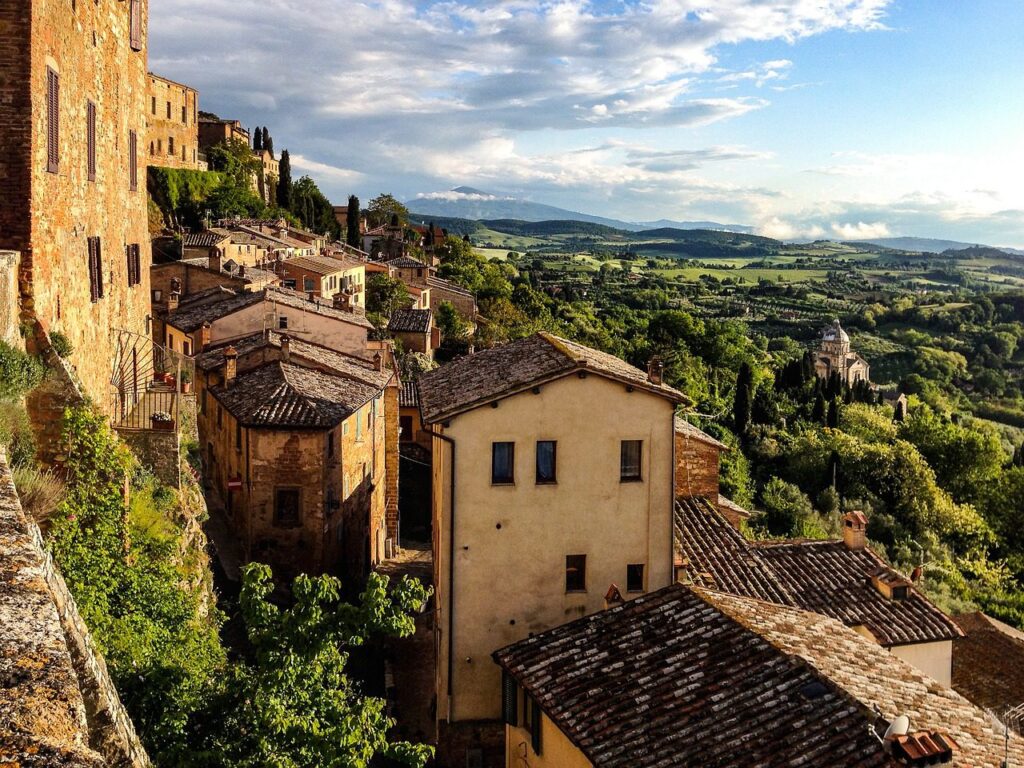
Tuscany is one of the world’s most famous wine regions and one of the clearest symbols of Italian wine culture. Known for rolling hills, historic estates, medieval towns, and some of Italy’s most respected bottles, Tuscany combines beauty and substance in a way few regions can match. This is the home of Chianti Classico, Brunello di Montalcino, Vino Nobile di Montepulciano, and the category that came to be known as Super Tuscan.
For wine lovers, Tuscany matters because it offers both identity and range. Sangiovese sits at the heart of the region, but the wines can move from bright, savory, and lifted to deep, structured, and long-lived depending on where the grapes are grown and how the wine is made. Tuscany is not just famous. It earns that fame.
KEY TAKEAWAYS |
| • Tuscany is one of Italy’s top wine regions, best known for Chianti Classico, Brunello di Montalcino, Vino Nobile di Montepulciano, and Super Tuscans. |
| • Sangiovese is the region’s most important grape and the backbone of many of its most famous wines. |
| • Tuscany’s varied terroir includes inland hills, coastal vineyards, limestone-rich soils, and major differences in altitude and climate. |
| • The region blends tradition and innovation, producing wines that range from classic and age-worthy to bold and modern. |
Table of contents
- What is Tuscany as a wine region?
- The history of Tuscan wine
- Tuscany’s terroir and key growing areas
- Sangiovese and other important grapes
- How Tuscan wines are made
- The main styles of Tuscan wine
- Why Tuscany is such a major wine travel destination
What is Tuscany as a wine region?
Tuscany, or Toscana, is one of Italy’s most important wine regions, located in the central part of the country between the Apennines and the Tyrrhenian Sea. It is a region with enormous cultural weight, but it also has real wine substance behind the postcard image.
What makes Tuscany stand out is the way place and grape variety connect so clearly. Sangiovese is the dominant red grape and the region’s signature variety, but the expression of that grape changes depending on whether you are in Chianti Classico, Montalcino, Montepulciano, or one of the coastal areas. That gives Tuscany depth as a wine region. It has a strong core identity, but not just one style.
Tuscany is also unusual in the sense that it holds both traditional prestige and modern influence. It respects long-established methods and appellations, yet it has also been central to some of Italy’s boldest wine innovation.
The history of Tuscan wine
Tuscany has a winemaking history that stretches back thousands of years. The Etruscans cultivated vines here long before the modern Italian state existed, and their connection to the land still forms part of the region’s wine story.
Later, during the Middle Ages and beyond, influential families such as the Medici and Antinori helped shape Tuscan wine culture and its reputation. Estates developed over centuries, farming knowledge deepened, and the region became one of the enduring centers of Italian viticulture.
That long history matters because many of Tuscany’s greatest wines still feel grounded in tradition. Even when producers embrace modern cellar work or international grapes, there is usually still a sense of continuity with the region’s older identity.
Tuscany is not a newly discovered fine wine region. It has been earning respect for a very long time.
Tuscany’s terroir and key growing areas
Tuscany’s terroir is one of the main reasons the region produces such varied and compelling wines. It stretches from inland hills to coastal zones, with changing elevations, different soil structures, and a broad mix of climatic influences.
That means Tuscany is not one uniform landscape. It is a patchwork of vineyard environments, and the wines reflect that.
Chianti Classico
Chianti Classico sits between Florence and Siena and is one of Tuscany’s most historically important wine areas. Vineyards here are often planted on hills with soils that include limestone, clay, schist, and galestro. These conditions help produce wines with bright acidity, red fruit, savory herbs, and firm but balanced structure.
Chianti Classico is often the first Tuscan wine region people get to know, and at its best it offers a perfect introduction to Sangiovese’s energy and food-friendliness.
Montalcino
Montalcino is warmer and often produces a deeper, more powerful expression of Sangiovese. This is where Brunello di Montalcino is made, and the wines tend to be more concentrated, structured, and age-worthy than many other Tuscan reds.
Altitude still plays a major role here, and vineyard position can influence everything from ripeness to freshness.
Montepulciano
Montepulciano is home to Vino Nobile di Montepulciano, another important Sangiovese-based wine. The style is often associated with balance, elegance, and a slightly more refined middle ground between everyday drinkability and long-term seriousness.
Bolgheri and the Tuscan coast
Along the coast, especially around Bolgheri, Tuscany shows a different face. Here the sea moderates the climate, and the region has become famous for wines made from Cabernet Sauvignon, Merlot, Cabernet Franc, and Syrah, either alone or in blends.
These coastal wines helped define the Super Tuscan movement and showed that Tuscany could excel with international grapes as well as native ones.
Sangiovese and other important grapes
Sangiovese is the star of Tuscany. It is the region’s defining grape and the backbone of many of its most important wines.
What makes Sangiovese special is its ability to transmit place clearly. It tends to show red cherry, sour cherry, dried herbs, tea, earth, and floral notes, along with naturally high acidity and tannic structure. Depending on the site and the producer, it can feel bright and lifted or dark, serious, and firmly built.
In Chianti Classico, Sangiovese is often blended with small amounts of other grapes, though the best wines still rely on it as the central voice. In Brunello di Montalcino, the grape appears in its local form, often called Sangiovese Grosso or Brunello, and produces one of Italy’s most age-worthy red wines.
Vino Nobile di Montepulciano is based on Prugnolo Gentile, a local name for a Sangiovese biotype that gives the wines their own regional identity.
Tuscany also includes important international varieties, especially in the coastal areas and in many Super Tuscans. Cabernet Sauvignon, Merlot, Cabernet Franc, and Syrah all play meaningful roles in certain parts of the region.
That mix of native and international grapes is part of Tuscany’s story. It has remained deeply tied to Sangiovese while still leaving room for experimentation and change.
How Tuscan wines are made
Tuscan winemaking sits somewhere between tradition and adaptation. Many producers still use methods that reflect long regional habits, while others have introduced more precise and modern techniques to refine style and quality.
Traditional approaches may include longer maceration, fermentation in larger vessels, and aging in large oak casks. These methods often aim for structure, longevity, and a less obvious oak profile.
Modern approaches may involve temperature-controlled fermentation, shorter extraction, and aging in smaller French oak barrels or barriques. These wines can show more polish, softer texture, and a more internationally familiar style.
Neither approach is automatically better. Tuscany is large enough to support both. What matters is whether the producer uses the cellar to clarify the wine’s character instead of burying it.
The region’s best winemakers understand that technique should support the vineyard, not overpower it.
The main styles of Tuscan wine
Tuscany produces several major styles, and together they show just how broad the region really is.
Chianti Classico
Chianti Classico is often the most recognizable traditional Tuscan red. It tends to show cherry fruit, fresh acidity, herbal notes, and a savory edge that makes it one of the most food-friendly wine styles in Italy.
With age, good examples become more complex, with leather, spice, dried flowers, and earth joining the fruit.
Brunello di Montalcino
Brunello is one of Italy’s great cellar wines. These are serious reds with concentration, tannin, acidity, and the ability to evolve for years. Young Brunello can be firm and structured, but mature bottles can be exceptional.
Vino Nobile di Montepulciano
Vino Nobile often sits slightly outside the spotlight compared with Chianti Classico and Brunello, but it deserves much more attention. The best examples are elegant, balanced, and highly satisfying, with enough structure to age but enough charm to be approachable earlier.
Super Tuscans
Super Tuscans are perhaps the clearest symbol of Tuscan innovation. These wines emerged when producers stepped outside strict appellation rules and used grapes like Cabernet Sauvignon and Merlot, sometimes blended with Sangiovese, to create wines on their own terms.
The category includes some of Italy’s most famous modern wines and played a major role in reshaping how the world viewed Tuscan wine.
Why Tuscany is such a major wine travel destination
Tuscany is not only a famous wine region. It is one of the world’s most appealing wine travel destinations. The scenery, villages, estates, food, and general atmosphere make it easy to understand why so many wine lovers want to visit.
Places like Siena, San Gimignano, Montepulciano, and Montalcino give travelers a chance to combine tastings with history, architecture, and regional food culture. That combination is a big part of Tuscany’s appeal. You do not just visit a winery. You step into a wider cultural landscape.
Agriturismos, historic estates, cellar tours, and village restaurants all help make the region feel immersive rather than transactional. Wine in Tuscany rarely feels disconnected from daily life. It is woven into the place.
Why Tuscany still matters
Tuscany matters because it produces wines with identity. You can taste the region’s structure, acidity, heritage, and confidence in the glass. It also matters because it has managed to stay relevant across different eras of wine drinking.
Traditionalists can still find classic Sangiovese-based wines with real aging potential. More modern drinkers can explore polished coastal blends and contemporary Super Tuscans. Casual wine lovers can enjoy approachable Chianti. Collectors can chase Brunello. Very few regions can offer all of that while still feeling coherent.
Tuscany is not just a beautiful wine region. It is one of the most complete wine regions in the world.
Read next
Last updated:


